Sunday, January 27, 2019

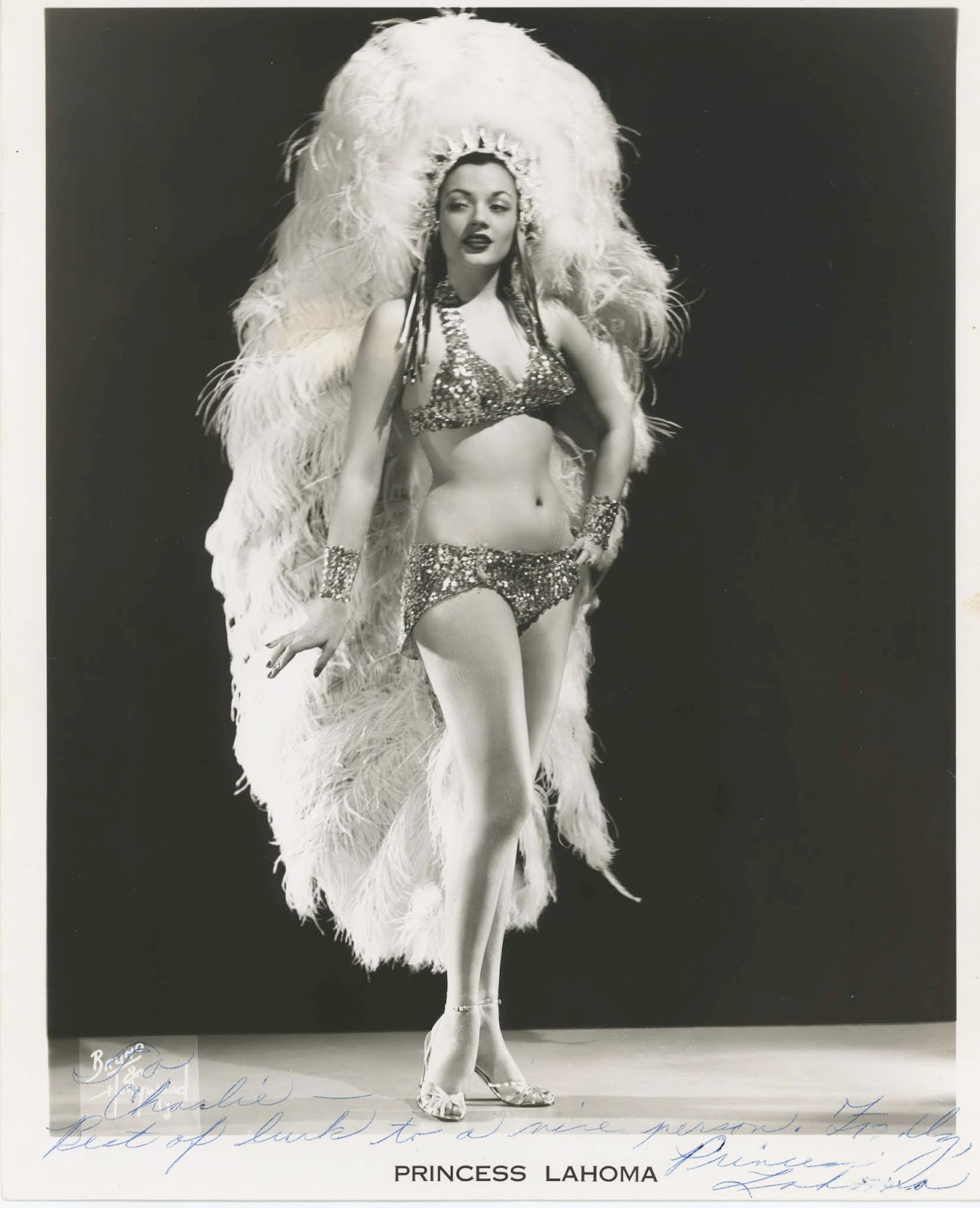
Princess Lahoma


This month my wife and I celebrated her birthday in Las Vegas. We go every year, not to gamble, but just to walk around, explore the new hotels, see the shows we haven’t seen, and watch the people. We saw a Cirque du Soliel show based on Beatles’ songs at the Mirage, a comedy show a Planet Hollywood, and a variety show at the Rio. We wandered through the Venetian, watched the gondolas, took our pictures with celebrities at Madame Tussaud’s wax museum, and of course I had to visit the Burlesque Hall of Fame, where my cousin Lahoma is featured.

It was six of seven years ago when I found out about the Burlesque Hall of Fame. A young woman e-mailed me from New York City where she was working as a nanny. She had read an article I posted here on my blog about Lahoma and wanted to know more about her. Her hobby was collecting pictures about burlesque stars from the past. She had a web site where she had collected hundreds of pictures and newspaper articles about burlesque. She shared what she already had about Lahoma, and she told me about the Hall of Fame in Las Vegas, which she was helping with her research. We corresponded for several weeks sharing information and eventually we collaborated in writing a little article about Lahoma for the museum.

I haven’t heard from my friend for a couple of years but I hope she compiled her work into a book. She certainly did an admirable job with her research.

Just visited her facebook page. She still has our article about Lahoma posted. She’s selling burlesque memorabilia on EBAY to raise money to pay vet bills for her aging dog, so check it out. http://www.burlyqnell.com

Visiting the Hall of Fame reminds me of what wonderful memories I have of my cousin Lahoma, and makes me think that I ought to record more about her life than just her time dancing.

During the late ‘40’s and early ‘50’s, when Lahoma was dancing, I was in elementary school, and I was madly in love with her. She was beautiful, glamorous, and she sent me stuff. The walls of my room were covered with pennants from all over the United States. I wrote her letters. I used to have a copy of one. On it I had drawn a picture of “Elfie,” the hero of my mother Wenonah’s bedtime stories.  

When Lahoma recycled her costumes, she gave them to me. I remember an Indian head dress made of purple ostrich feathers. It had a long train, or at least it was a train for me. On Lahoma, who was almost six feet tall, it probably barely reached the floor. I can’t imagine what our neighbors thought, seeing me run around wearing it. My cousin Steve says that he had one of her ostrich feather head dresses too that was white. It’s probably the one she’s wearing in the picture I put at the beginning of this article.

Lahoma’s mother, my Aunt Kaliteyo, lived in Oklahoma City. She wasn’t married, and she spent a lot of time at our house. She ate my mother’s corn bread and had milk and cookies with me when I got home from school. We kept up with Lahoma through Aunt Kaliteyo.
Every once in a while, Lahoma would come home for a visit. It was always an exciting time. She would show us pictures of the places she danced, and tell us about the famous people she knew. She dated a popular song writer of the day, Johnny Cola, who had written a new song, Vienni Su, that we were all hoping would be a success, for her sake.

Once she took me to a major production down at the Municipal Auditorium, just the two of us. It starred Victor Borga. There was singing and dancing, and of course he played the piano. Lahoma was very critical of the dancers. During the performance she pointed out all the things they were doing wrong. It impressed me that although she was a burlesque queen, she was still a serious dancer.

I’ll finish with a picture of me in one on Lahoma’s more traditional head dresses. I wore it on 89er’s Day at our school’s annual reenactment of the 1889 land run into Indian Territory by early settlers. Even at an early age I knew that not everyone was happy about taking away the Indians’ land.

Indian Brave at ‘89er’s Day Reenactment at Sequoyah Grade School in about 1949


That’s a tomahawk in my right hand.


To be continued.

Tuesday, January 1, 2019

Thoughts on Native American Culture


Whipping Tree, Chickasaw Council House Museum


My Uncle Haskell was an attorney and judge in Pauls Valley, Oklahoma, and a charter member of the Chickasaw Historical Society Board. He explained to me once that for the Indians, especially the full bloods, the concept of land ownership was totally foreign.  

He said that to them, land was like water or air, to be used by each person as needed. Before the white man came, they used land for hunting and for farming, and when game was scarce or during droughts, they moved on. There were boundaries between tribes, which changed with time depending on the size and needs of each tribe, but there was no such thing as land ownership.

After tribal boundaries were imposed by the US government, the Indians set up constitutions which reflected their tribal custom, designating land as common to all. Tribal members could use what they needed, but after their death, the land was returned to the tribe. This caused trouble within the tribe as some took advantage of the law to profit by subletting land to white men. The real tragedy though came in 1903, when tribal governments were dissolved and individuals were issued allotments.

Many Indians were so opposed to the allotment process, that they refused to be included on the tribal rolls compiled by the government, thereby eliminating themselves and their families from receiving allotments, and also future benefits of tribal membership.

It was mainly full bloods, who held onto their traditions more strongly, those who deserved the benefits most, who were left out, and even for those who signed the rolls, the concept of land ownership was so difficult for them that they often signed over title to their allotments for a night on the town. As Uncle Haskell told me, “They didn’t think land was worth anything.” So it wasn’t just that the Indians were opposed to private land ownership of land, they couldn’t even understand the concept.

The tragedy that befell the Indians during the allotment process is described in detail by Angie Debo in her book, “And Still the Waters Run.”

I include this story as an illustration of the tremendous power of culture and tradition to mold the thinking of the members of a group.

The Indians also had no concept of wealth. Often the chief was the poorest person in the tribe because he shared what he had with others. Possessions were shared. Poor or disabled members were taken care of. Even now the Chickasaw have what they call “giveaways.” People take household appliances, clothes, linens, furniture, whatever they don’t need, and give it away to whomever needs it more.

Gifts were even exchanged between enemies as a symbol of good faith. The Europeans didn’t understand this. There is an example in the Roanoke Colony story. During the first exploratory mission the explorers noticed that a cup was missing after a meeting with the Indians, and they retaliated by attacking the village and burning the Indians’ food stores. We have no explanation from the natives’ point of view, but I imagine that they would have expected the Europeans to share what they had.

Another difference in Indian culture I learned from my mother. She told me about the honesty and honor among the Chickasaw. In fact they did not even have jails, or at least not until quite late in their history. When a crime was committed, a date was set for the punishment and the guilty party was told to appear at a certain time and place for his or her punishment, usually lashes, and the guilty one always came to submit to his punishment, even if it was execution. The Chickasaws’ whipping tree has been preserved at their museum in Tishomingo, Oklahoma.

My mother explained that for the Indian the worst punishment wasn’t execution, but banishment from the tribe. An individual’s identity, his or her very existence depended on membership in the tribe.

In tribal society, the very concept of identity was dependent on tribal membership. A warrior’s name was given based on a characteristic or achievement, for instance “Running-deer” or “Ten-killer.” Also tribal members’ names might change from time to time depending on their position or rank. In an article recently published in the Chickasaw history journal, there is a discussion about whether or not the chief Tishominko was in attendance. In the article they say that “Tishumustubbee” is listed, and that in future documents listing Tishominko, Tishumustubbee is not mentioned.
Minko means chief.

Chickasaw society was, is matrilineal, which makes sense in a culture where the men are away much of the time hunting or at war, at risk of losing their lives. Lineage made a difference, and clan (family) membership was important. There were certain clans from which leaders were taken. Clans were thought to have characteristics, such as bravery, wisdom, or hunting ability.

At the same time tribal identity appears to have trumped lineage, or even race! The Chickasaws experienced intermarriage from an early time, especially with Scotch traders and missionaries and these men were adopted by the tribe. For this reason the Chickasaws were better able to negotiate with the government in their treaties. The mixed blood members understood English, and also they understood the the white man’s way of thinking, for instance on the issue of land ownership.

Early in Chickasaw history the Natchez Indian Tribe was decimated by the Spanish and the remnants were adopted by the Chickasaws.

Slavery was commonly practiced by many Indian tribes including the Chickasaws. Captives from raids on other tribes or survivors of battles were often made slaves, or servants, but with time many became members of the tribe. This applied not just to Native Americans though. Black runaway slaves were adopted by the Seminoles in Florida.  In fact, there were some tribes that were predominantly black.   

In the west, the Plains tribes frequently raided white settlements, taking hostages for slaves or ransom, but often adopting them into the tribe, and it was not uncommon for these hostages to refuse to return to their families when they were discovered. In other words, the Indians determined tribal membership not by family membership, but by performance and loyalty.

Thinking about my last article about the Lumbee tribe, I think that the Indians would have accepted the Lumbee as just another tribe, in spite of their genetic heterogeneity.

The tribal culture, the Indians’ concepts of ownership, and tribal identity, served them well possibly for millennia, but they are totally foreign to our way of thinking. I make two conclusions from these observations. First, the tribal culture works. There’s plenty of room for compassion, loyalty, generosity. The members of the group each have a place, they produce what they need, and they have security and support from their community.

The second, and perhaps the more interesting conclusion to me is that, not only is the tribal system efficient, it requires a totally different way of thinking. Its members are not just convinced. They are conditioned to think in a way that supports their system, and their conditioning is so strong that they have difficulty surviving in a different culture.

It makes you wonder, how are we conditioned by our culture? Does this conditioning prevent us from understanding or judging other cultures? Can we see the flaws in our own culture? Would our conditioning prevent us from adapting to another culture?


Sunday, December 30, 2018

The Lumbee


Henry Berry Lowrie


The Lumbee are the largest Indian tribe east of the Mississippi, numbering 35000 registered members and another 30000 who claim membership, according to Andrew Lawler, in his book, "The Secret Token." See posts: The Lost Colony, Nov. 11, 2018, and Virginia Dare, Nov. 21, 2018. In this fascinating book Lawler tells the story of the Roanoke Colony, the first British colony in the new world, and how its mysterious disappearance has fostered spooky stories of alien abduction, demon possession and fantasies justifying white supremacy.

Lawler devotes one chapter of his book to the Lumbee Indian tribe, who have incorporated into their traditions a completely different twist to the Roanoke story. According to the Lumbee, the Roanoke settlers didn’t disappear at all. Rather, they were rescued by the Croatoan Indians, the ancestors of the Lumbee. Today Virginia Dare is referred to as the Lumbee’s mother, and Lumbee sons are named Manteo in honor of the Croatoan warrior who returned to England with the first Roanoke party and then came back with the settlers to intercede for them with his people.

This tradition has served the Lumbee well over the years. During the Civil War a male member of the tribe was executed for refusing to dig a trench alongside African-American slaves, and after the war his son led a rebellion against the Ku Klux Klan and it’s persecution of people of color. The man, Henry Berry Lowrie, was never caught. In fact, he once robbed a bank of the reward money collected for his capture.

During the period of Indian Removal, the notorious Trail of Tears, the Lumbee were left in place, probably because white settlers didn’t covet their swampy land.

Later, in the 1880’s, a North Carolina legislator, Hamilton McMillan, wrote a book based on the tradition that the Lumbee had rescued the Roanoke settlers. In his book,
McMillan noted that many of the Lumbee had names similar to those of the settlers, for instance Berry, the name of the leader of the rebellion. He also cited a story of uncertain origin, of an Indian tribe found during the colonial period who spoke English. He then pointed out similarities of the dialects of contemporaneous Lumbee to “Old Saxon English.” As a result of McMillan’s theories, legislation was passed giving the Lumbee recognition as a tribe, voting rights, and better schools. He also made Democrats of them, insuring his tenure in the state legislature.

The Lumbee have a river named for them, the Lumber River, and a branch of the University of N. Carolina is located in the town of Pembroke, in the heart of Lumbee country. While recognized in N. Carolina, the Lumbee are not recognized by the federal government, not surprising since recognition would involve providing special benefits to tribal members.  

The origins of the tribe are vague. The word Lumbee comes from a Siouan word meaning “dark water.” They are located in an area that was originally swampy and remote, which became a refuge for escaped slaves, poor whites, and mixed blood people of color. It was a place where they could survive by hunting and fishing, and where they could escape persecution.

Efforts to link the Lumbee to the colonists have frustrated historians and archeologists, since there are few written records, and no archaeological trace of the colonists. Tribal members are suspicious and reluctant to participate in DNA studies, partly because of fears that it might jeopardize their continuing efforts to obtain federal recognition, but limited studies have been done and they are surprising. They show a high percentage Northern European and African ancestry, but no Native American!

Lawler quotes an Episcopal priest who claims Lumbee ancestry. “I am Proudly Lumbee,” he said , “but recognize that it is an identity constructed by my ancestors to secure a better deal for themselves in the Jim Crow South.”

I think he has every right to be proud.

Tuesday, November 20, 2018

Virginia Dare


Virginia Dare


Of all the people associated with the Lost Colony of Roanoke, Sir Walter Raleigh: adviser to Queen Elizabeth and sponsor of the colony, John White: governor of Roanoke colony and artist whose paintings were reproduced, published and circulated throughout Europe, shaping early attitudes toward the New World; Thomas Harriot: Oxford trained naturalist, mathematician and astronomer, who learned Algonquin to communicate with native Americans, invented navigation methods used into the twentieth century, plotted the most accurate maps of the North American coast made for two centuries, and cataloged the flora and fauna of the new world; none have inspired more interest and imagination than Virginia Dare, the first English child born in the new world.

Virginia, daughter of Eleanor and Ananias Dare and granddaughter of John White, was born on August 18th, 1587, on Roanoke Island off the east coast of what would later be North Carolina. She was baptized the next week, and shortly afterwards her grandfather left for England, never to see her again. All we know of her is the fact of her birth, recorded briefly in White’s journal.

The birth of little Virginia remained an obscure historical footnote until 1834, when George Bancroft, a Harvard historian, wrote a book about the lost colony, highlighting Virginia Dare as the first English child born in the new world. The book was a best seller, unusual for a history, but the country was going through some changes at the time that created a fertile environment for her story. Land hungry pioneers had successfully pressured Congress into passing legislation to remove Indian Tribes from the southeast, freeing up the fertile Mississippi valley for settlement. After the slave revolt led by Nat Turner in 1831, oppressive laws were being passed to keep down blacks, both enslaved and free. Americans of English and Scottish descent were searching for ways to justify their oppression of people of color.

About that time several books and magazine articles were written portraying Virginia Dare as a symbol of the purity and virtue of the white race. In an article in the Women’s Home Companion published in 1837, Eliza Cushing described the massacre of the Roanoke Colony by bloodthirsty savages, and the rescue of the infant Virginia by the loyal Manteo*, who protects her through her childhood. As an adult she is rescued from marrying a vicious savage with “uncontrolled passions” by a Spaniard who happens by. They then return to Spain with the Spaniard, where they raise Manteo’s son and cause him to forget his savage past. The story not only supports the superiority of the white race over the Indian "savages," it also supports the practice pursued into the twentieth century of separating Indian children from their parents and from their cultures, in order to “civilize” them.

Over the next almost two centuries many variations of the racist fantasy have been told.
Another story by Mary Mason in 1862 describes the virtuous Virginia Dare being transformed into a white doe by an evil Indian shaman. When she is later killed by a white hunter, she thanks him for freeing her from her curse and for supplanting the evil red man on the continent, supporting the doctrine of Manifest Destiny.

The Civil War only reinforced the Popularity of the Virginia Dare legend, as southern whites struggled to maintain political control of the South.

Around the turn of the 19th century, Sallie Southall Cotton wrote an epic poem about the Virginia Dare legend in which she transforms Dare into a Jesus like figure, comparing Roanoke to Bethlehem and even having Dare transform water into wine in her death scene. Cotton traveled around the country reciting her poem, and in 1896 formed the Roanoke Colony Memorial Association which raised money and bought Fort Raleigh, the site of the Roanoke Colony, where Virginia Dare's birthday has been celebrated ever since. Cotton also advocated scientific motherhood, advocating laws banning the mixing of the races in order to maintain the purity of the white race, an idea which was also popular in Nazi Germany.

Over the 400 years since the disappearance of the Roanoke settlers, Virginia Dare has been used as justification for segregation, lynchings, disenfranchisement of black Americans, limitation of immigration, and other manefestations of prejudice against people of color, in a disgraceful perversion of history. Even now there is a web site vdare.com which advocates limiting the immigration of non-europeans.

Information for this article was taken from "The Secret Token," by Andrew Lawler.

* Manteo was a Croatoan Indian who was taken to England by the first English exploration party, and became an ally of the colonists. Another indian, Wantese, also went to England, but returned to America to lead the resistance against the settlers.