Showing posts with label Kaliteyo Paul Willingham. Show all posts

Sunday, January 27, 2019

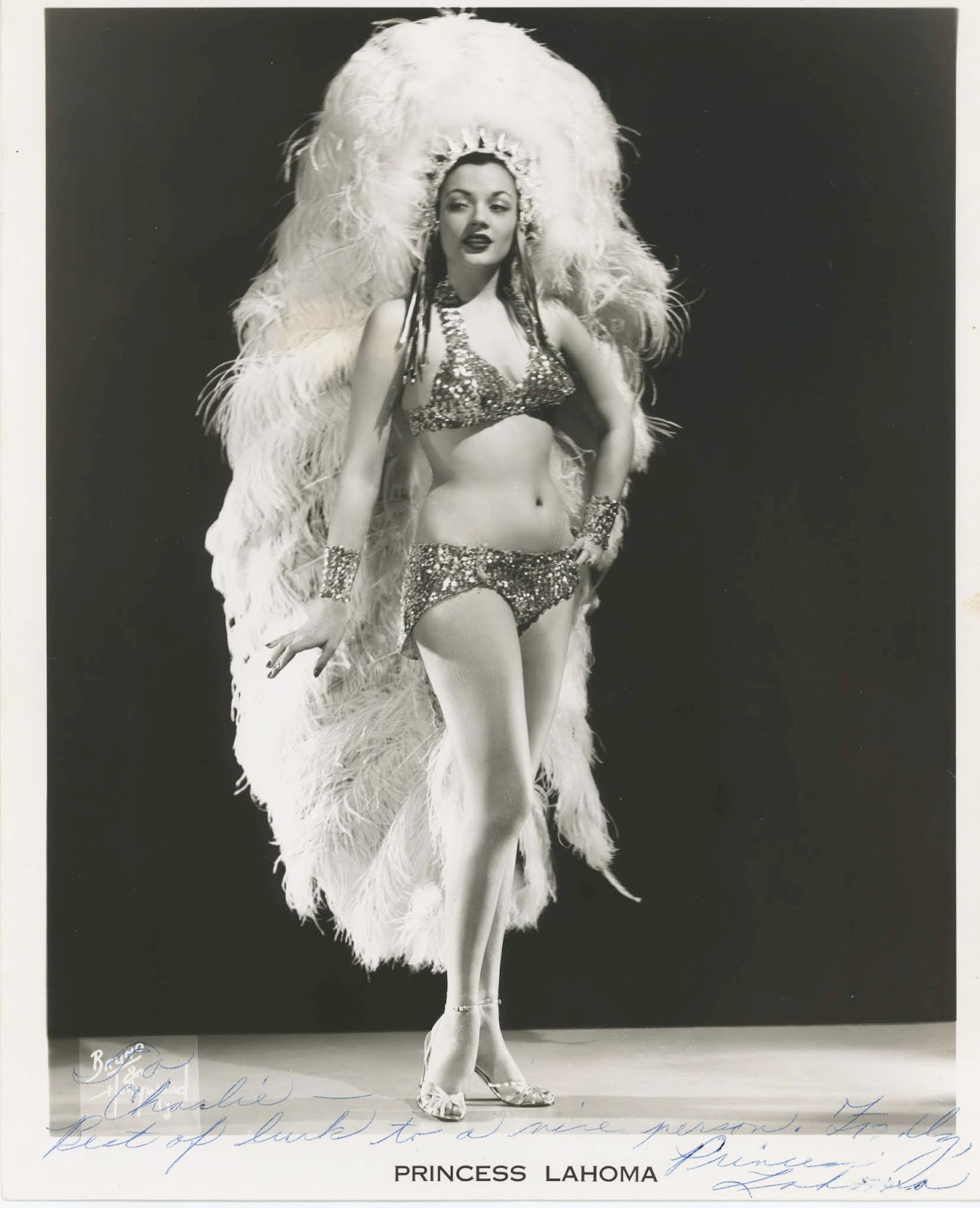
Princess Lahoma


This month my wife and I celebrated her birthday in Las Vegas. We go every year, not to gamble, but just to walk around, explore the new hotels, see the shows we haven’t seen, and watch the people. We saw a Cirque du Soliel show based on Beatles’ songs at the Mirage, a comedy show a Planet Hollywood, and a variety show at the Rio. We wandered through the Venetian, watched the gondolas, took our pictures with celebrities at Madame Tussaud’s wax museum, and of course I had to visit the Burlesque Hall of Fame, where my cousin Lahoma is featured.

It was six of seven years ago when I found out about the Burlesque Hall of Fame. A young woman e-mailed me from New York City where she was working as a nanny. She had read an article I posted here on my blog about Lahoma and wanted to know more about her. Her hobby was collecting pictures about burlesque stars from the past. She had a web site where she had collected hundreds of pictures and newspaper articles about burlesque. She shared what she already had about Lahoma, and she told me about the Hall of Fame in Las Vegas, which she was helping with her research. We corresponded for several weeks sharing information and eventually we collaborated in writing a little article about Lahoma for the museum.

I haven’t heard from my friend for a couple of years but I hope she compiled her work into a book. She certainly did an admirable job with her research.

Just visited her facebook page. She still has our article about Lahoma posted. She’s selling burlesque memorabilia on EBAY to raise money to pay vet bills for her aging dog, so check it out. http://www.burlyqnell.com

Visiting the Hall of Fame reminds me of what wonderful memories I have of my cousin Lahoma, and makes me think that I ought to record more about her life than just her time dancing.

During the late ‘40’s and early ‘50’s, when Lahoma was dancing, I was in elementary school, and I was madly in love with her. She was beautiful, glamorous, and she sent me stuff. The walls of my room were covered with pennants from all over the United States. I wrote her letters. I used to have a copy of one. On it I had drawn a picture of “Elfie,” the hero of my mother Wenonah’s bedtime stories.  

When Lahoma recycled her costumes, she gave them to me. I remember an Indian head dress made of purple ostrich feathers. It had a long train, or at least it was a train for me. On Lahoma, who was almost six feet tall, it probably barely reached the floor. I can’t imagine what our neighbors thought, seeing me run around wearing it. My cousin Steve says that he had one of her ostrich feather head dresses too that was white. It’s probably the one she’s wearing in the picture I put at the beginning of this article.

Lahoma’s mother, my Aunt Kaliteyo, lived in Oklahoma City. She wasn’t married, and she spent a lot of time at our house. She ate my mother’s corn bread and had milk and cookies with me when I got home from school. We kept up with Lahoma through Aunt Kaliteyo.
Every once in a while, Lahoma would come home for a visit. It was always an exciting time. She would show us pictures of the places she danced, and tell us about the famous people she knew. She dated a popular song writer of the day, Johnny Cola, who had written a new song, Vienni Su, that we were all hoping would be a success, for her sake.

Once she took me to a major production down at the Municipal Auditorium, just the two of us. It starred Victor Borga. There was singing and dancing, and of course he played the piano. Lahoma was very critical of the dancers. During the performance she pointed out all the things they were doing wrong. It impressed me that although she was a burlesque queen, she was still a serious dancer.

I’ll finish with a picture of me in one on Lahoma’s more traditional head dresses. I wore it on 89er’s Day at our school’s annual reenactment of the 1889 land run into Indian Territory by early settlers. Even at an early age I knew that not everyone was happy about taking away the Indians’ land.

Indian Brave at ‘89er’s Day Reenactment at Sequoyah Grade School in about 1949


That’s a tomahawk in my right hand.


To be continued.

Monday, April 22, 2013

Mignon Laird


Lately I have been rereading my book, the one about my mother and her family, looking for errors, awkward sentences, etc., and I discovered a really interesting story that I just have to share, even if it means interrupting the story of my dad’s life.  

In the chapter I just finished editing, my mother Wenonah is telling about a time when she was ten. It would have been about 1923. During that year her older sister, Kaliteyo, who was thirteen, had a toothache. The toothache kept getting worse, until a swelling developed under her jaw. One day she was riding a horse across the yard, forgot to duck and a tree branch struck her right under the jaw, knocking her off the horse. 

Kaliteyo wasn’t hurt by the fall, but the limb of the tree punctured an abscess that had extended from the root of her sore tooth completely through her jaw bone. I remember the scar. Grandmother ran outside when she heard the commotion, and saw pus and blood running down Kaliteyo’s neck.   

Well, Pauls Valley didn’t have a permanent dentist at the time – that’s the reason Grandmother hadn’t gotten help sooner, but after seeing the huge abscess she knew she had to do something. It just so happened that a dentist had just rolled into town, in a Pullman car. I found a picture of the car in a Pauls Valley. Centennial brochure. 


The dentist’s name was Dr. Laird, who lived with his family in a Pullman car which he moved from town to town. When he came to a new town, he would have his Pullman car rolled off onto a side track and stay there until he saw as many patients as needed him. Then he would move on.  

My mother told me that Grandmother let her go along when she took Aunt Kaliteyo to see Dr. Laird, so she got to see the inside of the Pullman car. She told me that the inside was really fancy. It had beautiful velvet drapes with tassles on the pull cords, and elegant rugs and furniture.  

Oh, by the way, Dr. Laird pulled Kaliteyo’s tooth, and her jaw eventually healed, even though it took a long time and a lot of follow up visits to Dr. Laird.   

The other thing that my mother mentioned was that Dr. Laird had a daughter who played the harp. She told me that she heard her play and that she was very good.  

I found out a little more about Dr. Laird from a brief note on the Pauls Valley Centennial brochure. It says there that Dr. Laird’s daughter, whose name was Mignon, went on to become a professional dancer in New York City. I didn’t look into the story any further at first. It did strike me as funny to imagine Mignon running and leaping through a railroad car, trying to practice her dancing.  

But on rereading my chapter, I got curious about Mignon’s career, so I “Googled” her. Isn’t the internet a wonderful thing? The first thing that I encountered was the Mignon Laird Municipal Airport, in Cheyenne, Oklahoma. She had an airport named after her! 

Digging deeper I found a book about the Katy Northwest Railroad which describes a local service they ran from town to town in Oklahoma. The book says that Dr. Laird used that service to move his Pullman car from town to town. Also, according to the book, Dr. Laird did a lot more than pull teeth. He put on “medicine shows” by which I suppose they mean he sold some kind of tonic which was supposed to heal whatever ailed you, and part of the show was Mrs. Laird and Mignon giving readings and singing, and Mignon playing the harp. It might have been at one of these performances that my mother heard Mignon play. 

In looking for information about Mignon’s career, I found a blog by a lady named Laura Haywood about the “Ziegfield Club” which was a group of ladies in New York who had performed in the Ziegfield Follies, and who would get together from time to time to reminisce. Ms. Haywood attended some of the club’s meetings and got to know Mignon Laird, who was one of the club’s charter members. Mignon’s told her that her act consisted of dancing with her harp, which she somehow managed to play at the same time.  

Mignon was also part of the cast of a broadway show called “Who Cares” which played for 32 performances in 1930. 

Finally, I found on the New York Public Library site a spectacular photograph of Mignon, playing the harp and dancing in the Ziegfield Follies!


Mignon Laird in the Ziegfield Follies - 1920's
(Files of New York Public Library)


Sunday, September 23, 2012

Kaliteyo


                                           Kaliteyo Paul Willingham
 
Aunt Kaliteyo was my favorite aunt. It's not that I didn't love my Aunt Oteka too, but I didn't see her as much.  I kind of grew up with Aunt Kaliteyo. She would be at home visiting with my mother Wenonah when I got home from school, and we would have milk and cookies together. She loved to raid our ice box for corn bread. She taught me to swim, how to sit up straight, and how to answer the phone with "Gunning's residence." She was my buddy.
 
Aunt Kaliteyo was named after one of my great, great, great aunts, a sister of Ela-teecha, from whom we all get our Chickasaw blood. This aunt Kaliteyo was married to one of the Maytubby's. Floyd Maytubby, her great grandson, was the Chickasaw governor when I was little. I mentioned him in my story: The First Chickasaw Princess, published Oct 5, 2011.  
 
After my mother's death I found among her papers a legend about the origin of the Maytubby name. The document was written by Mrs. Agnes Trousdale, one of our Maytubby cousins. The story was never used by the historical society, and I haven't written about it myself until now, afraid that I might be infringing on the rights of the Maytubby's, but I've finally decided to write an abridged version with the idea of preserving the story for our family and for the tribe. I'm assuming that Mrs. Trousdale wouldn't mind since she gave it to my mother, Wenonah.
 
Mint-Ubbe, The Origin of the Chickasaw Name of Maytubbe
 
Long ago, before the coming of the white man, there was a great hunter among the Chickasaw. He could see farther, walk more softly, and shoot an arrow straighter than any of the other warriors. The tradition at that time was for each person to be given a name which represented a characteristic he possessed or a deed he had performed, but the chiefs had not given this warrior a name, since they could not think of one worthy of him.
 
In the same village lived a beautiful maiden called Kaliteyo, or "running water," because of the musical laughter which flowed forth from her mouth like a babbling brook. The great warrior and the lovely maiden Kaliteyo had long been exchanging glances when the warrior's mother delivered a bundle of clothes to the mother of Kaliteyo. This was the traditional manner of proposing marriage among the Chickasaw. If Kaliteyo accepted the bundle, it meant that she had accepted the warrior's proposal.
 
Of course Kaliteyo happily accepted the bundle; the two were married, and for many moons they lived happily together. Soon a son was born to them, and then another and another.
 
As the years passed, game became scarce near the village, and the hunters struggled to provide enough meat for the tribe. Finally, one autumn, when the stores of meat became low, the chiefs announced that if the hunters did not find game soon, the tribe could not survive the winter. So, bidding his wife and sons goodbye, the nameless hunter set out to find a new hunting ground.
 
The great hunter searched for many days, travelling far and wide, and finding only small game, but no deer or buffalo. Finally, fearing that his family might be starving, he gathered up what little meat he had found and started for home. Meanwhile, Kaliteyo, worried that her husband had been attacked by a wild beast or captured by a hostile tribe, left their children with her mother, and set out to find him.
 
After a few days, Kaliteyo came to a small valley filled with tall grass. As she looked she thought she saw something move. Then she saw them. She couldn't believe her eyes. In the valley was a large herd of buffalo. As she lay there, wondering if she had the strength to kill one of the massive beasts herself, she heard a noise. Not knowing whether the noise came from a wild animal or a hostile warrior, she lay still and waited. Then who should emerge from the forest but her husband, the nameless warrior.
 
Kaliteyo, overjoyed at finding her husband safe, and excited that they could now end the tribe's famine, began running toward her husband pointing toward the buffalo and calling out to him, "Mint-ubbe! Mint-ubbe!" - "Come and kill them! Come and kill them!" As the great hunter came over the ridge he saw them too, and quickly began releasing arrows into the herd.
 
As soon the nameless one had killed enough buffalo to feed the tribe for the winter he and his beloved Kaliteyo returned home to summon the other warriors to help butcher the meat and carry it back to the village. Afterwards there was a great celebration and the old chiefs finally gave the great hunter a name - Mint-ubbe.


Wednesday, April 4, 2012

St. Elizabeth's Academy


As I mentioned in my previous blog post, after my mother Wenonah got permission to go to school at Bloomfield, my Aunt Kaliteyo begged to go away to school too. She didn't want to go to Bloomfield though, but rather to St. Elizabeth's.  


                                          Kaliteyo Paul Willingham


Mildred McClure, Wenonah and Kaliteyo's cousin, had been attending school at St. Elizabeth's, and she had been telling Kaliteyo how much she enjoyed it there. 

(Footnote: Mildred McClure's grandfather was Tecumseh McClure - see previous posts.) 

I'm sure that it was hard on Grandmother to let Kaliteyo go away to school. She had always been sickly, and she must have been afraid that she would come down with something at the school. Kaliteyo was determined though, and Grandmother finally gave in.  

St. Elizabeth's Academy was in Purcell, Oklahoma, about as far north of Pauls Valley as Bloomfield was to the south. Like Bloomfield, it was a school for Indian girls, and while it wasn't as old as Bloomfield, it also had a colorful history. It was founded by the Order of St. Francis, which sent three nuns to the Chickasaw Nation in 1888 to establish a school. The church and school buildings were built by Benedictine priests who lived nearby.  


                                           Sister Katherine Drexel


The project would have certainly failed had it not been for the efforts of Benedictine priest Vincent Jolly, who taught at the Sacred Heart Academy in Pottawatomie County. He had heard about the work of Sister Katherine Drexel, a nun from a wealthy Philadelphia family who was using her fortune to fund schools in Indian communities. Father Jolly convinced Sister Katherine of the need for schools for the Indians in Oklahoma, and for the next sixty years St. Elizabeth's was supported by Sister Katherine's generosity. 

Sister Katherine was an outspoken advocate for oppressed Native Americans and African Americans. She financed more than 60 missions and schools throughout the south and southwest, as well as Xavier University of Louisiana, the only historically black Roman Catholic university in the United States. She also founded a religious order, the Sisters of the Blessed Sacrament, composed mainly of Indian and Negro nuns. In 2000 she was canonized and became the second American born saint.  

St. Elizabeth's started as a coeducational school, but by the time Aunt Kaliteyo went there in 1926 it was for girls only. Kaliteyo loved the nuns, and she also must have been popular among the other girls. Kaliteyo's best friend at St. Elizabeth's was Tula Mae Graham, a Choctaw girl from Purcell. She said that she and Tula Mae entertained the other girls after lights out by imitating their teachers. 

Some of the nuns at St. Elizabeth's had been at the school since before statehood. One of the sisters told the girls about how she had stood on a hill near the convent and watched the big land run of 1889.  

Piano lessons were among the classes offered at St. Elizabeth's, and the girls were assigned time during each day for practice. I don't know if Kaliteyo got very good at playing the piano, but she certainly enjoyed herself. My mother said that the lady who played the piano for the high school glee club in Pauls Valley used to bounce up and down on the piano stool as she played. She  was a bit overweight, so the spectacle was funny to the girls. Kaliteyo liked to mimic her, and one day she was doing her imitation at St. Elizabeth's when one of the sisters came into the room. Kaliteyo said that the sister laughed with everyone else, but she made her stop.  

Kaliteyo's favorite story about St. Elizabeth's was about her friend Tula Mae trying to smuggle apples up to her room. There were some apple trees on the school grounds, and when the apples began to get ripe the girls were told not to pick them. Tula Mae and Kaliteyo wanted to take some of the apples up to their room, but they were always supervised when they were outside. Finally Tula Mae got an idea. The girls dressed very modestly in long dresses with bloomers under their skirts so Tula Mae stuffed some apples down into her bloomers during recess. Everything went well until she started back to class. As she joined the line of girls filing back to class, the draw string on one leg of her bloomers came loose and the apples began falling out. As she walked by, one of the nuns noticed the trail of apples behind her and got tickled. The nun was trying to be stern, but Kaliteyo said the girls could tell she was laughing by the way her belly shook.  

Kaliteyo got through the year at St. Elizabeth's without getting sick, which must have been a relief to Grandmother, and when the summer vacation was over she asked to go back for a second year. She always treasured her memories of St. Elizabeth's, and when her daughter Lahoma was about eight, she sent her to St. Elizabeth's day school. Lahoma enjoyed her time there too, and she had some of the same teachers as her mother.  

Footnote: See blog post of Oct. 5, 2011, The First Chickasaw Princess.

Lahoma enjoyed St Elizabeth=s like her mother had before her. My mother told me about visiting her once at an open house at the school. As Lahoma showed her around, excited to have a visitor, she told her about a nun whom she especially liked, and as they were walking across the school grounds, Lahoma suddenly exclaimed, AThere she is,@ and she rushed over to where the nun was standing, pulling my mother along behind her. As they came up to her, the nun turned around and Lahoma=s face fell. She turned to my mother and said, AThis is the wrong one.@ The nun just laughed.  

St. Elizabeth's struggled through the depression and through the war years, but in 1948, with dwindling funds and falling enrollment, its doors were closed for the last time.


                          St. Elizabeth's Academy, Purcell, Oklahoma