Showing posts with label Kaliteyo. Show all posts

Saturday, August 15, 2020

Bob Dog


The dog my mother Wenonah remembered from her childhood was “Bob Dog.” The Dog part of the name was necessary because Wenonah’s younger brother was also named Bob. 

Bob Dog was a bull dog. The picture below doesn’t look much like a bull dog to me, but it’s the one Wenonah identified. She was getting older and her eyesight was failing when she told me, but I’ll show the picture anyway since it’s the only one I have.         

                                                                   Bob Dog 

Wenonah’s older brother, Willie, originally bought two bull dogs. The other was named Queen, but Queen didn’t work out.  After Willie brought the dogs home he was in the yard talking to a friend of his, and Queen charged them. Before anyone could react, Bob Dog ran in front of Queen and knocked her away. So Willie got rid of Queen, and Bob Dog instantly won the trust and gratitude of the family. 

After that, Bob Dog became part of the family. He was playmate to Wenonah’s younger brother Tom and her younger sister Oteka. Grandmother liked to work on her quilts upstairs in Willie’s bedroom over the porch. Wenonah’s older sister Kaliteyo would sit with her and help thread her needles. As they worked, they would watch the children play, and later, Kaliteyo would entertain the family with stories of their antics. Bob Dog patiently followed Teker and Tom around the yard, even as they dressed him in old shirts and shorts, harnessed him to their wagon, and tied tin cans to his tail. 

Wenonah was more in charge of Bob Dog’s practical necessities, like food, which he liked, and baths, which he didn’t. Mamma would say, “Jim, Bob Dog needs a bath,” and he knew what she meant. “Sometimes I could catch him,” Wenonah said, “but if I didn’t, he would leave and be gone for a week.” Wenonah said that he went to “West Town,” the “colored” part of town. “He had a girl friend over there,” she said. 

Bob dog was big and strong, but he did have one weakness, and that was thunderstorms. Wenonah said that as soon as he heard the first clap of thunder he would run into Mamma’s room and hide under her bed. That usually worked fine, along with a few comforting pats from whomever was nearby, but one evening when the clouds started gathering, Bob Dog found himself alone, trapped in the dining room. Mamma had taken the children to the movies. Mamma’s dining room was separated from the rest of the house, and from Mamma’s bedroom, by sliding doors. They were huge, and heavy, more of a partition than doors, and they were covered by heavy green velvet curtains. They were pretty, with a fleur de lis pattern embroidered along the bottom. Unable to get through the door to Mamma’s room, Bob Dog attacked those curtains, tearing them with his teeth and with his claws. By the time the family got home from the movies, they were in shreds. 

Bob Dog also possessed that supernatural connection to the family members that some dogs seem to have. When Wenonah was at OU, and would ride the bus home for a visit, Bob Dog always met her as she walked home. Somehow he knew she was coming. Oteka said he met her too. 

Bob Dog met with an untimely end. With Wenonah, Bob, and Tom away at school, and Kaliteyo and Oteka married, he spent more and more time away from home. One day he came home cut in several places and bleeding. It was his last trip to West Town. Bob Dog died in Mamma’s arms.  

Friday, February 8, 2019

Little L


Little L


As a child, my cousin Lahoma was known as “Little L.” My mother Wenonah said that she was always generous, sweet and cheerful. “Nobody could stay in a bad mood when Little L was around.”

It must have been hard for Little L to stay cheerful, because she had a tough childhood. She grew up during the depression and during WWII, raised by a single mother, my aunt Kaliteyo, who during most of her childhood, eked out a living as a seamstress.

Kaliteyo quit school in 1931 to marry a young man from the nearby town of Paoli, Oklahoma. She stayed with him for four years in spite of the fact that he spent most of his weekends out drinking, usually with other women. Kaliteyo got a divorce in 1936, but that didn’t end her troubles. The next year she and Little L were overwhelmed by fumes in a garage apartment where they were living. It was a wonder they survived.

After their close call, Kaliteyo and Little L moved in with Grandmother in Pauls Valley, while Kaliteyo looked for a job. Grandmother was happy to have a granddaughter to spoil, and she also had a playmate for her, her cousin Tom, the son of my uncle Haskell, who was also recently divorced. As soon as Kaliteyo recovered from carbon monoxide poisoning, she enrolled in a secretarial school in Oklahoma City, staying with Wenonah, who had a job with the state highway department, and leaving Little L in Pauls Valley with Grandmother.

This was too much for Little L. She thought Wenonah had taken her mother away. One weekend when Kaliteyo and Wenonah came home for a visit, Little L kicked Wenonah in the shin  So Kaliteyo quit school and moved back to Pauls Valley. Eventually she got a job there working for the new welfare department created under President Roosevelt’s New Deal.


Little L and Kaliteyo


The next problem came when Little L started to school. Her teacher said that she paid attention in class, but just couldn’t seem to understand the lessons. She wasn’t learning to read and she couldn’t understand math. The whole family worried about her. Finally her teacher noticed that Little L couldn’t see the blackboard. Wenonah, who still had a job, went out and bought her some glasses. She never had trouble in school again.


The next year Kaliteyo was transferred to Purcell, Oklahoma, and that gave her an opportunity to send Little L to St. Elizabeth’s Academy, where she had gone to school during her high school years. Lahoma loved it, just like her mother. Wenonah told me about visiting her once during an open house. Little L was excited that Wenonah had come, and she proudly showed her around and introduced her to her teachers. There was one nun at the school whom she particularly liked and she kept looking for her. Finally she cried, “There she is,” and ran to where one of the nuns was standing. When the nun turned around, Little L said, “Oh, it’s the wrong one.” The nun just laughed and said, “We do look alike in our habits.”

Aunt Kaliteyo tried to give Little L a good childhood, but she always had trouble making ends meet. She eventually lost her job in Purcell and moved to Oklahoma City, where she tried to make a living as a seamstress. Wenonah worried about them. She said that one time she went by to visit and all they had in the refrigerator was a stick of butter.

Little L always found a way to be cheerful. As soon as she was old enough she got a job at a flower shop to help out. She always made sure her mother had flowers in their apartment. In spite of their poverty Kaliteyo managed to give Little L dancing lessons, starting in grade school, and she was really talented. She danced in recitals, and at school programs, and once for the Indian-Okla Club that Wenonah belonged to. Yvonne Chouteau, who would become a famous ballerina, was about the same age as Little L, and she danced on the same program.


Little L , 1939


When my parents were married in June of 1941, they moved into an apartment just a block down the street from Kaliteyo and Little L. On November 7 of that year, called by President Roosevelt “the date that will live in infamy,” the US naval fleet in Pearl Harbor was attacked by the Japanese. The nation was in shock, but especially my parents, because my dad’s brother Everett was assigned to the USS Oklahoma, one of the ships that was sunk. 

After the attack, Little L came by to visit Wenonah every day after school.  "Lahoma was always cheerful," Wenonah told me. "She tried to give us hope that Everett had survived." Christmas was coming, but as the days went by, and there was still no word from Everett, celebrating the holiday was the last thing on my parents’ minds. One day Little L came in and said, “You need some Christmas decorations,” and she proceeded to hang some tinsel and ornaments she had bought with her meager savings.

It was January before Everett was able to get word to the family that he was okay. My parents thanked God that he was alive, and they thanked Lahoma for helping them get through the weeks of worry. Wenonah told me that my dad carried Little L’s picture in his wallet for years.

After about a year my mother thought of another way to show her thanks. At the time there was an annual Indian Exposition in Anadarko, Oklahoma, attended by Indians from all over the United States. The family had been going to the “Indian Fair” ever since it began in 1935, and she noticed that some of the tribes selected a “Princess” to represent them, so she called our cousin, Floyd Maytubby, then the Chickasaw Governor, and asked him if he would consider appointing Lahoma. He did, and she was crowned Chickasaw Princess in 1943. She was twelve. 


Little L with other tribal princesses, 1943


In 1948, when Little L was just 15, her dancing teacher, Molly Day, decided to start a professional dancing troupe, and she invited her to join. But she needed $500 from each girl for startup money. I don’t know what Lahoma thought. I guess the idea seemed exciting and glamorous. The surprising thing was that her mother supported her. She still regretted not being able to follow her own dreams.

When the family found out what Little L was planning, they were horrified. They tried to talk Kaliteyo out of allowing her to go. Then they refused to give her the money. We were living in Wichita, Kansas at the time, but grandmother kept Wenonah in the loop. Finally Kaliteyo got the money from her boyfriend, and so Little L, just out of junior high school, headed for Texas and later Mexico, performing with a dancing troupe.  

To be continued. 


Sunday, January 27, 2019

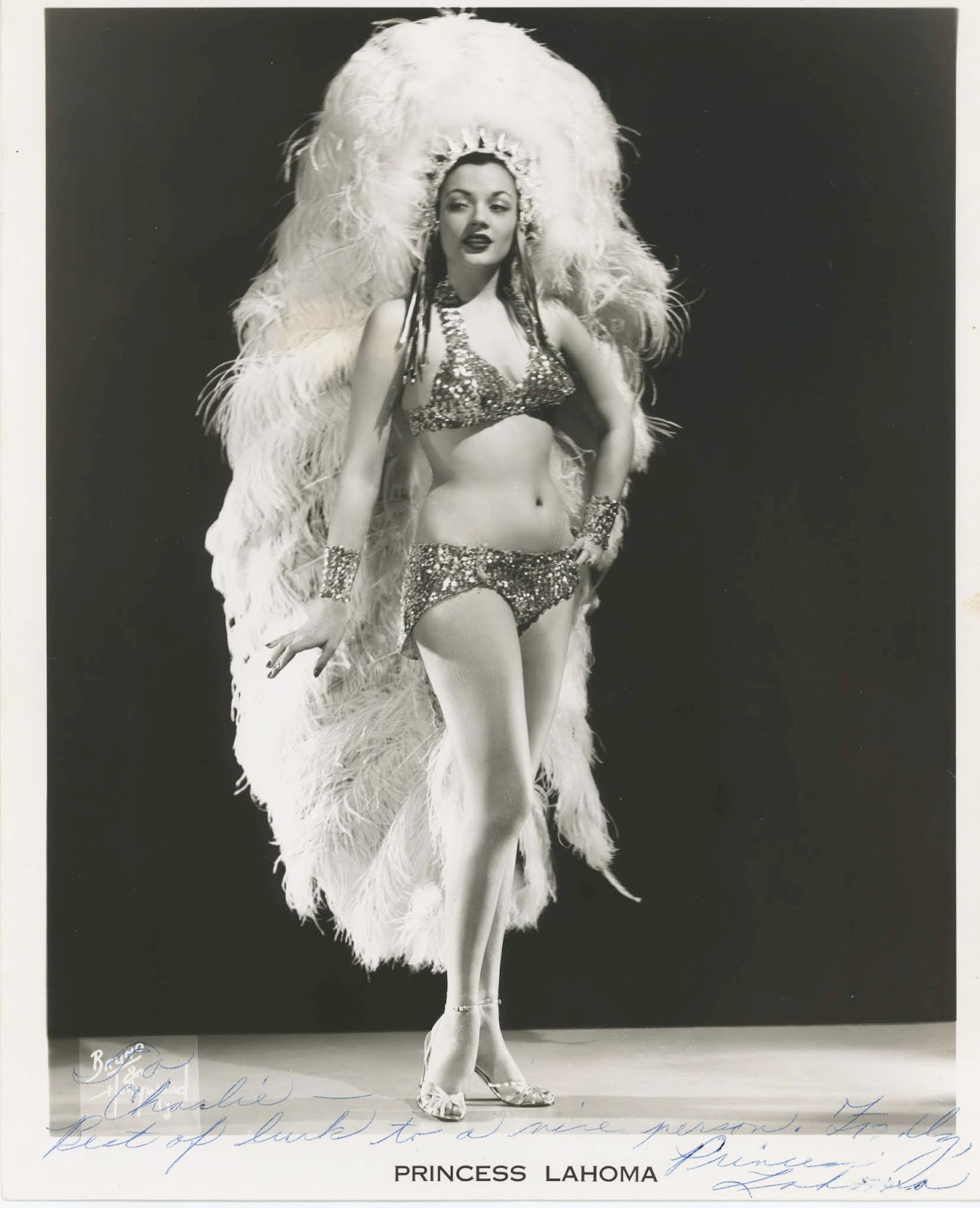
Princess Lahoma


This month my wife and I celebrated her birthday in Las Vegas. We go every year, not to gamble, but just to walk around, explore the new hotels, see the shows we haven’t seen, and watch the people. We saw a Cirque du Soliel show based on Beatles’ songs at the Mirage, a comedy show a Planet Hollywood, and a variety show at the Rio. We wandered through the Venetian, watched the gondolas, took our pictures with celebrities at Madame Tussaud’s wax museum, and of course I had to visit the Burlesque Hall of Fame, where my cousin Lahoma is featured.

It was six of seven years ago when I found out about the Burlesque Hall of Fame. A young woman e-mailed me from New York City where she was working as a nanny. She had read an article I posted here on my blog about Lahoma and wanted to know more about her. Her hobby was collecting pictures about burlesque stars from the past. She had a web site where she had collected hundreds of pictures and newspaper articles about burlesque. She shared what she already had about Lahoma, and she told me about the Hall of Fame in Las Vegas, which she was helping with her research. We corresponded for several weeks sharing information and eventually we collaborated in writing a little article about Lahoma for the museum.

I haven’t heard from my friend for a couple of years but I hope she compiled her work into a book. She certainly did an admirable job with her research.

Just visited her facebook page. She still has our article about Lahoma posted. She’s selling burlesque memorabilia on EBAY to raise money to pay vet bills for her aging dog, so check it out. http://www.burlyqnell.com

Visiting the Hall of Fame reminds me of what wonderful memories I have of my cousin Lahoma, and makes me think that I ought to record more about her life than just her time dancing.

During the late ‘40’s and early ‘50’s, when Lahoma was dancing, I was in elementary school, and I was madly in love with her. She was beautiful, glamorous, and she sent me stuff. The walls of my room were covered with pennants from all over the United States. I wrote her letters. I used to have a copy of one. On it I had drawn a picture of “Elfie,” the hero of my mother Wenonah’s bedtime stories.  

When Lahoma recycled her costumes, she gave them to me. I remember an Indian head dress made of purple ostrich feathers. It had a long train, or at least it was a train for me. On Lahoma, who was almost six feet tall, it probably barely reached the floor. I can’t imagine what our neighbors thought, seeing me run around wearing it. My cousin Steve says that he had one of her ostrich feather head dresses too that was white. It’s probably the one she’s wearing in the picture I put at the beginning of this article.

Lahoma’s mother, my Aunt Kaliteyo, lived in Oklahoma City. She wasn’t married, and she spent a lot of time at our house. She ate my mother’s corn bread and had milk and cookies with me when I got home from school. We kept up with Lahoma through Aunt Kaliteyo.
Every once in a while, Lahoma would come home for a visit. It was always an exciting time. She would show us pictures of the places she danced, and tell us about the famous people she knew. She dated a popular song writer of the day, Johnny Cola, who had written a new song, Vienni Su, that we were all hoping would be a success, for her sake.

Once she took me to a major production down at the Municipal Auditorium, just the two of us. It starred Victor Borga. There was singing and dancing, and of course he played the piano. Lahoma was very critical of the dancers. During the performance she pointed out all the things they were doing wrong. It impressed me that although she was a burlesque queen, she was still a serious dancer.

I’ll finish with a picture of me in one on Lahoma’s more traditional head dresses. I wore it on 89er’s Day at our school’s annual reenactment of the 1889 land run into Indian Territory by early settlers. Even at an early age I knew that not everyone was happy about taking away the Indians’ land.

Indian Brave at ‘89er’s Day Reenactment at Sequoyah Grade School in about 1949


That’s a tomahawk in my right hand.


To be continued.

Sunday, August 8, 2010

She Cried Like Mamma Was Whippin' Her with the Ironin' Cord

I don't want to imply that Jim and Bob got away with fighting and breaking the glass in the back door without any punishment. Mamma tried her best to make them behave. Jim said that she gave them a lot of spankings, mostly for fighting.

All of Mamma's children got spankings, and the younger children sometimes got advice from their older siblings on how to avoid punishment. Jim said that Snip told Haskell if he cried real loud during a spanking Mamma would feel sorry for him. I doubt if this worked more than once or twice.

Jim's brother Bob had a little dog named Ring that was protective of him, and she said, "Ring would try to take the switch away from Mamma when she spanked Bob, and she would get tickled and stop."

Mamma had different levels of spankings. When the children were little she would hold their heads between her knees and slap their bottoms with her hands. As the children got older she used a switch. Since Jim and Bob were always together, they usually got spanked together. Jim said, "Mamma would tell each of us to go get a switch for the other. I would get a normal sized switch and Bob would pick out a 'limb' for me." Mamma's youngest children, Oteka and Tom, got into trouble together too, and although it was Jim's opinion that they got off easily, Oteka told the same story about Tom.

For the worst offenses Mamma would get out the 'ironing cord.' This was the removable cord that connected the iron to the electrical socket. The ironing cord was strong; it was narrow enough to sting, and its surface was rough enough to scratch the skin. The ironing cord would bring tears to even the toughest of Mamma's boys.

Once when I was little my Uncle Tom and Aunt Kaliteyo went to the show together. They were both single and sometimes they would double date. The next day they were both over at our house and Tom was teasing Kaliteyo about crying in the movie. He said, "Kaliteyo cried just like Mamma had been whippin' her with the ironin' cord."

Monday, August 2, 2010

Earliest Memories


This picture was taken in about 1917, when Jim, or "Jamie" as she was called then, was about 4 years old. It's one of my favorite pictures of my mother. She had just refused to join the other children for a family portrait. She had climbed up on the porch thinking she was out of the picture, but the photographer - Pappa? - included her anyway. Actually there's another picture taken later, after Jim had been coaxed down to join the group, but I like this one better.

The other children are - starting from the left - Haskell age 10, Bob age 2, Kaliteyo age 7, and Homer (Snip) age 13. Absent from the picture is Jim's oldest brother Willie, who was 16 at the time this picture was taken. He was away at military school in Alton, Illinois.

Haskell was Mamma's "Angel boy." He was neat, studious, and shy. Once when he was little a teacher prejudiced against Indians kept him in after school, and Pappa made a visit the superintendent. Haskell was changed to a different class. Mamma's comment was, "If you don't like Indians you shouldn't live in Indian country."

Bob was a toddler at this time but he would soon become Jim's favorite playmate. They climbed trees together, and played on top of the family's two story house. They went to the farm, about three miles from town, and rode the horses, and they fought. Jim said, "The glass window in the back door was always broken from being slammed when Bob and I chased each other."

Kaliteyo and Jim had completely different personalities. As Jim put it, "Mamma tried to make a lady out of Kaliteyo." Actually Mamma kept Kaliteyo inside most of the time because she was 'sickly' instead of letting her run and play with the other children. Kaliteyo was four years older than Jim, and Mamma made her take Jim along when she visited her friends. Kaliteyo eventually came to think of Jim as a pest. The two sisters had to sleep together though until Kaliteyo went off to college. Jim recalled, "I would try to snuggle up to Kaliteyo when it was cold. I can still feel her elbow in my ribs."

Jim's other brother, Homer, nicknamed "Snip" because his baby picture had a corner snipped off, was as opposite from Haskell as Jim was from Kaliteyo. Snip was outgoing and popular in school but he never studied. Jim said, "When Snip graduated from high school Mamma said she wanted to go out on the front porch and yell Hallelujah!" Snip loved animals and he always had several pets.

At this time Jim's "Grandpa" lived with the family. Jim, his namesake, was his favorite, and she remembers him singing to her and telling her stories. Grandpa always had several pins stuck in his lapel that he had picked up off the floor so the children wouldn't step on them. He chewed tobacco and spit into a spittoon which sat in the living room. Stuck in every roll of tobacco was a pin with the figure of a donkey on the end. Jim cherished the collection of donkeys that Grandpa had given her. Every day after breakfast Grandpa would put on his hat - he never seemed to know where it was even though it was always in the punch bowl where he had thrown it the day before - and walked down town to visit with his 'cronies.'

Mamma and Pappa were having conflicts by this time, but it seems that the family had adjusted to it. Pappa drank, but his drinking was in sprees and Jim said that he was never drunk at home. He got dressed every morning in a suit and tie; went out and revved up his Model A Ford, - Jim said he loved to race the motor - and drove off to his real estate office downtown.

In spite of her parents' conflicts Jim said, "Mamma and Pappa always loved each other." Pappa never had affairs with other women, and Mamma kept getting pregnant. Mamma had ten children all together, and Jim's youngest brother Tom was a "change of life" baby. Mamma devoted herself to her children. Jim said, "When I think of Mamma, I think of babies." Once when Mamma had just returned from picking up Pappa stranded after one of his "toots," she recalled, "I was sitting in the train on the way to Oklahoma City, and I kept thinking that something was missing. Finally I realized it was because I wasn't holding a baby."