Showing posts with label Seminole Indians. Show all posts

Tuesday, March 15, 2011

Changes in Indian Territory Brought About by the Mexican War and the Gold Rush.

          The following is just a little bit of historical information about the changes that went on after my great great grandparents were married in 1844. It was a time of change, and the Chickasaws were right in the middle of it. I don't have too much specific information about Smith and Ellen's lives during that time. I do know that they moved twice. In 1846 they moved nearer to Fort Washita for protection, and in 1851 they moved next to the newly constructed Fort Arbuckle which was located in the middle of the Chickasaw district and in the middle of the fertile Washita River valley. In spite of the protection offered by the forts, Smith and Ellen still faced repeated raids by plains Indian tribes, and in spite of that harassment they managed to have three children, my great grandfather Sam Paul, born in 1845, my great aunt Mississippia, and my great uncle Jessie.

          In 1846 the United States admitted Texas to the Union, and sent out an army under Zachary Taylor to guard the southern border. Taylor's troops went to the Rio Grande River, and were attacked by the Mexican army, who believed that the border should be further north, at the Nueces. Thus began the Mexican American War. As General Taylor fought his way down through Mexico, the U.S. Navy blockaded the coast, and General Winfield Scott landed at Veracruz. In 1847, Scott's troops occupied Mexico City, and in 1848 President Polk forced the Mexican government to cede all of their territory north of the Rio Grande River to the United States. The U. S. paid only $18 million. The area included, in addition to Texas, the present states of California, Nevada, Utah, New Mexico, Arizona, Colorado, and parts of Oklahoma, Kansas, and Wyoming. It was a better deal then the Louisiana Purchase.

          The Mexican American War was a turning point for the plains Indians. During the previous decade the Texans had been systematically driving Indians out of their republic, and Mexican agents had been backing Indian raids on Texas settlements. The Mexicans had also spread the rumor that the Americans were planning to build a big town on the Canadian River, and to kill all the buffalo, a story that would prove to be close to the truth. Now the hated Texans were a part of the United States, and there was no longer any barrier to the westward expansion of American settlers. American agents were now trying to negotiate with the plains tribes for the safety of travelers on the Santa Fe Trail.

          Two of the fiercest tribes on the plains were the Comanche and the Osage. They had joined in a peaceful alliance together after signing a treaty brokered by the United States in 1835. The treaty was supposed to guarantee safety for the immigrant tribes, but the Comanche and Osage took advantage of their alliance to steal horses from Texas. The Comanche would steal the horses, and the Osage would exchange guns and other supplies for them. Both tribes attacked travelers on the Santa Fe Trail. Without Mexican support, their system was breaking down, and they were also losing the buffalo, which they still relied on for food, clothing, and shelter. The Osage and Comanche both turned to the Five Civilized Tribes for advice.

          In 1849, Oh-he-wek-kee nephew of chief Tab-a-que-na of the Comanche, who had signed the treaty of 1835, sought out John Jumper, chief of the Seminoles, and also Wild Cat, their speaker. Jumper and Wild Cat were sympathetic with the Comanche's plight, having suffered at the hands of the Americans in Florida, but they knew that it was futile to fight. Wild Cat advised the chief to make peace, to settle down, and to raise corn and cattle. Oh-he-wek-kee also visited the Creek chiefs who gave him the same advice.

          In 1848, after the death of Black Dog, the great Osage Chief, the tribe split into two groups, one led by a young warrior called "The Wolf," and the other led by Black Dog's son, "Young Black Dog." The Wolf came to see John Ross, Chief of the Cherokee, to ask for advice. Ross informed him of the Americans' victory over the Mexicans, and he counseled him to settle down and make peace with the whites. Wolf's group followed Ross' advice, settled among the Cherokee, and took up farming. Young Black Dog's group continued to live as buffalo hunters.

          During the early 1800's many of the plains tribes had become fragmented into independent bands, so in spite of treaties, conferences and decisions on the part of some leaders, there were still plenty of raids on Chickasaw settlements. That is why my great great grandparents had to live near a fort.

          In 1848, not did the U. S. acquire Texas and the Mexican territory west to the Pacific, gold was also discovered in California. Soon thousands of settlers were heading south to Texas and west to California. Also trade through Santa Fe had grown to $2 million per year by 1854. All three trails went through Indian Territory, so the Chickasaws became innkeepers again, just like they had been in Mississippi along the Natchez Trace. Suddenly there was a market for their services and for their produce.

          The Gold Rush was good for the Chickasaws in another way too. It provided the political pressure for the building of another fort further west to protect the travelers. Fort Arbuckle was built in 1851 further up the Washita River, right in the middle of the Chickasaw domain. Smith and Ellen moved there right away, and they were followed by other Chickasaw families. In 1844 only 25% of the Chickasaws lived in their own district. In 1853 the figure was 90%.

Saturday, January 1, 2011

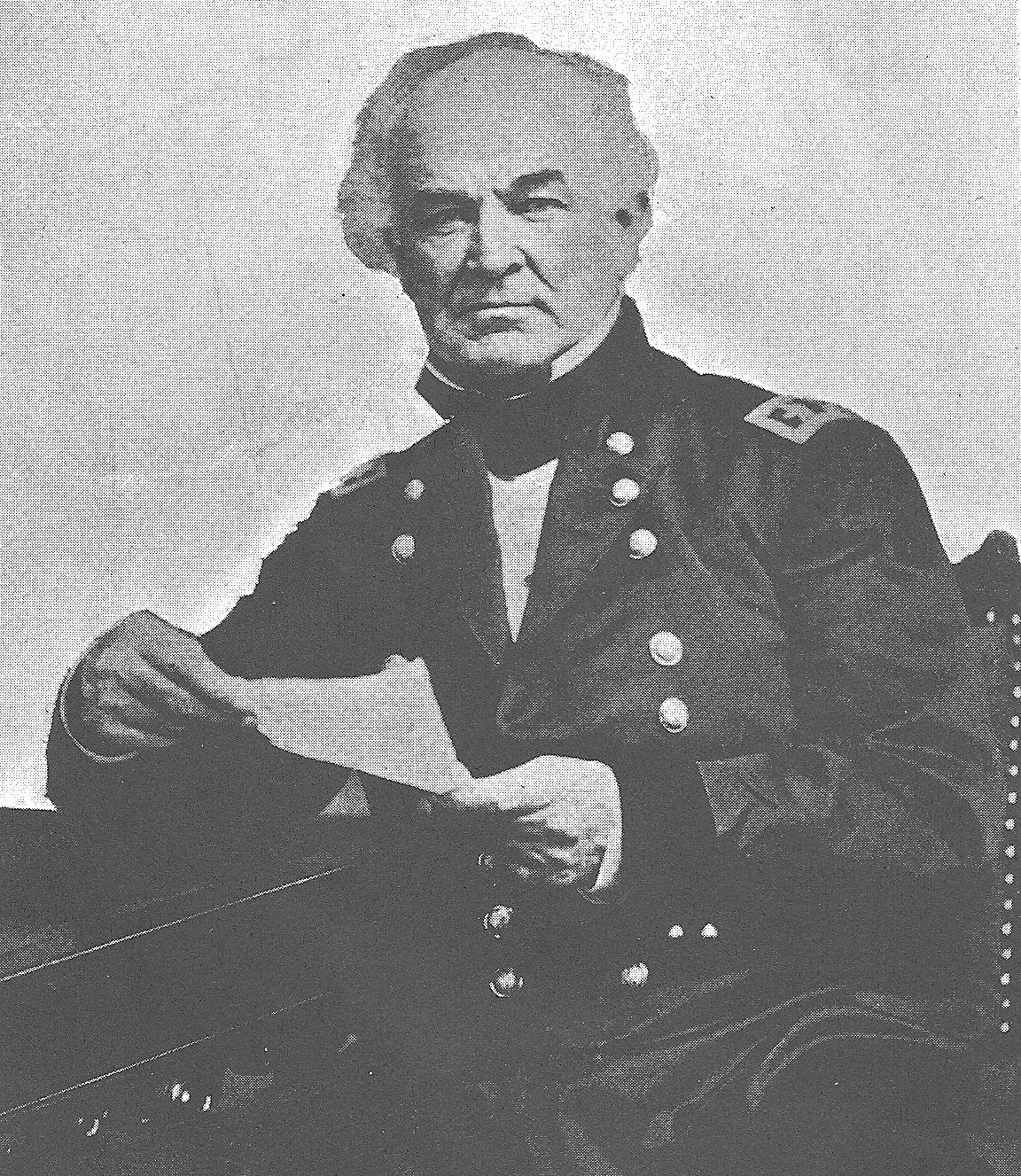
Ethan Allen Hitchcock


                                   Major General Ethan Allen Hitchcock

          Ethan Allen Hitchcock was named after his grandfather, the Revolutionary War hero, Ethan Allen. He graduated from West Point in 1817, stayed on as an instructor, and served as commandant of cadets from 1829 until 1833. In 1836 Hitchcock served in the Florida campaign against the Seminole Indians. He was appalled by the injustices committed against the Seminoles, and he reported his views to the war department. In 1840 when William Henry Harrison was elected president, Hitchcock was appointed special advisor for Indian affairs. 

          Complaints from the Five Civilized Tribes over the management of their removal attracted enough attention in Congress that in 1842,  the Secretary of War, John Bell, sent Hitchcock to Indian Territory to investigate. Hitchcock travelled throughout the territory for six months, meticulously documented the Indians' condition, and the history of their treatment during the Removal. On returning to Washington he submitted a detailed report.

          Hitchcock said in his report that "worn out oxen and bulls were forced on half starving people at an exorbitant price. Various white men are pointed out as having made $10,000 to $20,000 each in a year in this plunder of the helpless. Bribery, perjury, and forgery were the chief agents in these infamous transactions." "Spoiled rations to the value of $200,000 had been sold to the Chickasaws," and they were charged $700,000 for rations that were never delivered. Short weights in grain and beef occurred daily. The Chickasaw contractor was paid 14 - 16 cents per ration where the usual rate was 6 cents. The transportation rates were also "shockingly high." The rate for transportation by boat from Memphis to Ft Coffee was $14 per person with $2.50 added for luggage. Three thousand Chickasaws travelled by boat and they were charged $108,000. The total amount withdrawn from the Chickasaw fund for the Removal was $1.5 mil.

          Hitchcock concluded "the air is full of scandals." He expressed "astonishment, disgust, and indignation," and promised "that the foul transactions shall be probed to the bottom and the thieves punished." He observed that "It will certainly appear very extraordinary that the portion of the Indians over whom the Government assumed a guardianship should be precisely those fixed upon for a sacrifice."  

          Hitchcock' report was suppressed at first. The Secretary of War refused to release it to Congress. Not cowed by the powerful politicians, Hitchcock accused the administration of trying to protect government officials implicated by his report. When the report was finally released, the matter was investigated further but nothing was done. A token repayment was made to the Chickasaws almost 50 years later.

          Ethan Allen Hitchcock truly stands out as one of the good guys of history. Even though he failed to win justice for the Five Civilized Tribes in Indian Territory, he was given one more chance to help the Indians. In 1843 he was sent to Florida with orders to put down what was left of the Seminole revolt. Unlike his predecessors Hitchcock treated the Seminoles with respect and compassion, and managed to end the conflict without further violence.

          Ethan Allen Hitchcock retired from active military service in 1867 and devoted himself to reading and writing about philosophy and history. One of the most interesting of his works is the diary he kept during his journey through Indian Territory in 1842.

          When I took out the diary, published as A Traveller in Indian Territory, edited and annotated by Grant Foreman, to review my notes for this article, I couldn't put it down until I had reread the entire book. I can't think of a single work that I can recommend more highly. The diary contains a wealth of information about the way of life of the Five Civilized Tribes at the time, as well as their beliefs, their culture, and the challenges they faced.

          Hitchcock was fascinated and impressed by the tremendous strides the Indians were making toward creating a new life for themselves in the wilderness. The fact that there are virtually no accounts of the time recorded by the Indians themselves makes Hitchcock's observations are even more valuable.

          Hitchcock questioned everyone he met. He learned from one of his guides, a negro called Sambo, how the Chickasaws started fires on the hills to rouse the bears for a hunt. He spoke with a man who accompanied a band of Osages on a buffalo hunt, how they carried rifles but killed the buffalo with bow and arrow, how the Indians rode bareback without using the reins, and how their ponies were trained to chase the buffalos and then to veer off as soon as their rider's arrow had struck its mark. Hitchcock tried eating buffalo tongue, but it was so rich it made him sick.

          Hitchcock commented on the neatness and refinement of the Indian women. He described an Indian church service where the parishioners were so sincere that "Carlyle himself would have been pleased." He told of the public cooks in Tahlequah, the Cherokee capital, who prepared food that was free for anyone who was hungry. He was invited to attend a session of the Cherokee council where he was impressed with the orderliness and dignity of the proceedings. He visited a mission school and reported how well the Indian students were reading. He described a Cherokee ball where the ladies and gentlemen danced to a reel "more complicated than the old Virginia Reel" for 22 hours, stopping only 10 minutes for breakfast. 

          The only place in the diary where Hitchcock expressed impatience was when he was stranded in a storm bad enough "to make a saint curse," with "no one to talk with but a man who says he is from New York, and shows his importance by inquiring about the progress of building the exchange, etc., and asking me if I think we shall have war with England. I'll start out after dinner if it rains pitchforks."  

          Hitchcock visited Indian Territory soon after the great conference of Indian tribes held in 1839 by the Cherokees. He told of writing to Washington recommending that the government treat the Cherokees with more respect because of the great influence they had on the other tribes. Hitchcock described visiting the site of construction of Fort Washita, built to protect the Chickasaws against raids by the hostile tribes as they moved into their assigned lands. He suggested to the commander of Ft Gibson that he distribute rations to the starving Seminoles, and that he issue orders to forbid trade in alcohol. 

          Hitchcock's visit to Indian territory was during a time of monumental change. The Chickasaws were being raided by the Shawnee and Wichita Indians from the west, and by white settlers from Mexico (now Texas) to the south. He met some of the great men of the time:  Sequoyah, the creator of the Cherokee alphabet, John Ross, Samuel Worcester, the Creek chief Opothleyaholo, Roley McIntosh, the Chickasaw leaders William McGillivray, Sloan Love, Isaac Alberson, and Pitman Colbert. He heard Cyrus Kingsbury preach. He visited Edwards' trading post, where the Comanches came to exchange hostages kidnapped from white settlements in Mexico, and he stayed at the home of my step great great grand father, Jason McClure. (See post of 12/22/2010)

To be concluded.

Tuesday, October 26, 2010

Removal, The Seminoles


                             Osceola,
               Painting by George Catlin, 1838

It was March 27, 1814. The Tennessee militia, 5000 strong plus several hundred Indian allies, attacked a settlement of 1000 Creek Indians at a point along the Tallapoosa River called Horseshoe Bend. With no mercy the militiamen killed over 800 Creek Indians, the greatest slaughter of Native Americans in history. Among the littered bodies was a mother who lay across her child to protect him.

The name of the commander of the Tennessee Militia responsible for this slaughter was Andrew Jackson, who, as President of the United States would later drive the Seminoles from their homelands. The child's name was Osceola, destined to lead the Seminoles in their struggle against removal.

The nucleus of the Seminole tribe was the Oconee, who lived in the southern Georgia area prior to 1700. The group was first referred to as Seminole, which means 'runaway' in Creek, in the mid 1700's after they had migrating to Spanish Florida to avoid the encroachment of their lands by British settlers. They were joined there by the remnants of the Yamassee tribe which was almost wiped out in 1715 by the British colonists. During the next hundred years the Seminoles were also joined by escaped negro slaves, and by groups of Creek Indians also fleeing the settlers. Among the latter was Osceola's mother, who with her son and about 1000 other Creeks sought refuge among the Seminoles in 1814.

Over the years Georgia plantation owners made repeated raids into Seminole villages in Spanish Florida in search of "runaway slaves," kidnapping anyone of negro descent. The Seminoles in turn made raids on Georgia settlements.

In 1818, after an exchange of attacks across the Florida border by US government forces and Seminoles, Andrew Jackson, now a general, was given permission by President Madison to invade Florida. He went in with 4000 troops, advancing to Pensacola, destroying Seminole villages as he went. This became known as the First Seminole War.

Unhappily, Florida was ceded by Spain to the United States in 1819, and the treaty was ratified in 1821, bringing the Seminoles under US jurisdiction. Almost immediately settlers began pouring into Florida and demanding that the Seminoles be evicted from the choice farm land where they lived. In 1823, the Seminoles were forced to move into a swampy area east of Tampa Bay that was almost uninhabitable. Soon they were starving.

By 1828 when Andrew Jackson was elected president, settlers were clamoring for more land. Many Indians had already moved to the "Indian Territory" west of Arkansas. and in 1830 the Indian Removal Act was passed by Congress, making it official government policy to remove the Indian tribes from their native lands east of the Mississippi River, and giving the President authority to force them to go.

The Seminoles, barely surviving in the swamps of Florida, and still subjected to raids by the greedy Georgians looking for cheap slaves, signed a treaty in 1832, promising to exchange their land in Florida for land in Indian Territory if the land was found to be suitable by the tribe. 

Later in 1832 the Seminoles sent a party west to look at their new home. When the exploring party arrived, they discovered that the land they were being offered was located between the Creeks and the Osages who were at war. The next year another exploring party was sent. The situation in Indian Territory had become more stable and the Seminoles were satisfied with their location, but they were not authorized to make a decision for the tribe. Nevertheless, they were pressured into signing another treaty in which they agreed to accept the land chosen for them.

When the exploring party returned, the tribal leaders were incensed over being tricked. The black members of the tribe, who were very influential, objected to the original treaty which incorporated the Seminoles into the Creek tribe. They feared that the Creeks would demand they be turned over as slaves.  

The treaty allowed three years for the removal to take place. Since the Seminole leaders had never approved the treaty, they made no effort to comply. In 1835 when the time for removal had expired, the government agent, Wiley Thompson, read a letter from President Jackson to Seminole leaders, informing them that if they refused to migrate willingly, they would be removed by force.
During the years since the removal treaty had been signed, a new leader had arisen among the Seminoles, Osceola. Not only had Osceola witnessed the Creek massacre at Horseshoe Bend as a child, he had lost his negro wife in a slave raid as an adult, and he had been thrown into chains by the Seminole agent for speaking out. Osceola continued to speak out, and by 1835 most of the Seminoles supported him.
  
For Osceola, agent Thompson's threat to remove the Seminoles by force was the last straw. Osceola killed Thompson himself, along with several employees of the agency. Charley Emathla, a Seminole chief who had signed the removal treaty was also killed. On the same day another band of Seminoles attacked a company of government troops on their way to enforce the removal. Out of 110 soldiers, there were only 3 survivors. Thus began the second Seminole War.

The war had the overwhelming support of the Seminole people and their chiefs. Osceola sent a letter to General Clinch, in charge of US troops:

 You have guns, and so have we - you have men, and so have we - your men will fight, and so will ours, until the last drop of Seminole blood has moistened the dust of this hunting ground.

When the first group of 1100 US troops was sent to Florida to quell the rebellion, Osceola's warriors pinned them down for 10 days, forcing them to kill their horses for food. The Indians then asked for a truce, saying they were tired of fighting. General Gaines, commander of the army troops, thinking that the Indians had given up, sent the volunteer portion of his forces home.

Two chiefs, with about 400 of their followers, asked to be transported west. The rest of the Seminoles moved their families into the swamps and prepared to fight.

The Seminoles held out against the US Army for the next seven years. Their villages were burned; their crops were destroyed and their livestock was sold. Small groups of warriors would emerge to attack army units, only to melt back into the forest. When the soldiers waded into the swamps to follow the Indians, they were rarely able to make contact.

Over the years the Seminoles learned to survive in the marshes. They killed small game and fished. They crushed the native coontie root to make flour for bread, and they boiled the palmetto palms for cabbage, and ate the palmetto fruit. But the Indians suffered from constantly hiding and being on the run. 

One army officer described the conditioin of a group of Seminoles who came in to meet with General Macomb in the spring of 1839: 

"The men were destitute of clothing other than a buckskin shirt; and the women and children were almost in a state of nudity. Those who had covering were wropped up in old forage bags, picked up in the vicinity of abandoned posts; they were truly objects of commisseration."

One by one the Seminole chiefs surrendered with their people and were shipped out to join their brethren in Indian Territory, some in chains. The Indians, most of whom were already ill, were given inadequate care and supplies. They arrived in Indian Territory without clothing to shield them from the cold climate. About 20% of the migrating Indians died in route.   

General Jesup who was being criticized in the popular press for his failure to round up the Seminoles, became totally unscrupulous in his dealings with them. He allowed slave traders to select slaves from among the Seminole negroes who had surrendered, which was expressly prohibited by a treaty he had personally negotiated. He also hired Creek warriors to go on slave raids, promising freedom to negroes who would help him search for the Seminoles hiding in the swamps, and selling the rest into slavery. 

Jesup captured Seminoles who came in to parley under a flag of truce. He captured the principal Seminole Chief Mikanopi in this way and finally Osceola. This failure to abide by the time honored rules of war was even criticized in the white press.

In the fall of 1837, John Ross, chief of the Cherokees, who were having troubles of their own over the government's removal policy, offered to go to Florida to help pursuade the Seminole leaders to end their futile struggle. He and a group of Cherokee leaders followed Seminole representatives deep into the swamp for a meeting. As a result a large band of Seminoles who were assembled in hopes of a settlement were captured and made prisoners by General Jesup.

Incensed over being used as a tool for Jesup's treachery, John Ross appealed unsuccessfully to the Secretary of War for the Indians to be released.

A group of Army Generals, disgusted by the prolonged struggle, met with General Jesup to pursuade him to give up his struggle for this Florida swampland, and as a result, Jesup wrote a letter to the Secretary of War, asking for an end to the fighting: 

In regard to the Seminoles, we have committed the error of attempting to remove them when their land is not required for agricultural purposes; when they were not in the way of white inhabitants...As a soldier, it is my duty, I am aware, not to comment upon the policy of the Government, but to carry it out in accordance with my instructions... My decided opinion is, that unless immediate emigration be abandoned, the war will continue for years to come. 

The Secretary replied that he was powerless to suspend operations. 

Meanwhile, Osceola, who had inspired and led the Seminoles in their struggle, lay dying in prison. George Catlin, the famous artist, came to Ft. Moultrie to make a portrait of this valiant warrior. Osceola's wives brought him his ceremonial garb and he carefully painted his face with war paint and sat for the artist. He posed for four days, and then on the fifth day, January 30, 1838, unable to lift himself from the floor, Osceola died.    

After the death of Osceola, the US Army carried on the Seminole war for another three years. More chiefs gave up their struggle to continue their miserable existence in the Florida swamps. Those who surrendered were forced to leave without possessions. Their livestock, and their ponies had been sold. Their fields and homes had been burned. Many died as they were being transported as captives and deposited at Ft. Gibson in Indian Territory. The survivors stayed near the fort, dependant on the meager rations provided by the Army, and unable to move to their assigned lands because those areas had already been settled by Creeks. Several hundred Seminoles never surrendered, and the descendants of these proud people still live in the Florida Everglades.

The Seminoles lost about 40% of their population in the war and in the removal, but the survivors persisted in their struggle for sovereignty. Finally in 1856 the Seminoles were assigned their own domain in Indian Territory and were allowed to form their own government, independant from the Creek Nation.