Showing posts with label Comanche. Show all posts

Sunday, May 20, 2012

The Chickasaw Horse


                                          The Chickasaw Horse
        (From article in the Chickasaw Times by Holmes Willis Lemon in 1977)

I've started reading a book entitled Empire of the Summer Moon, by S. C. Gwynne, which tells the story of the rise and fall of the Comanche empire.
I guess I've been kind of racist in lumping the plains tribes together. I never realized that the Comanche had built an empire, but Gwynne makes a compelling argument. Anyway, I'm spellbound by the book. It's so nice to have a book about about Indian history on the best seller list.

Gwynne claims that the Comanche achieved dominance in the west by their  mastery over the horse. In his narrative he relates one of my favorite stories from the memoirs of Randolph Marcy, who made several trips west as far as California through Comanche country.   

Marcy was camped near a band of Comanche, and one morning saw two young Comanche women jump on their horses armed only with lariat ropes and chase a herd of antelope. As he watched in amazement, the girls each managed to corner and lasso one of those magnificent animals. 

I'll quote to you another story from Marcy's journal, about the Comanches' love of horses.  

I once made an attempt to purchase a favorite horse from a chief of one of the bands of the Southern Comanches, and offered him a large price, but he could not be persuaded to part with him. He said that the animal was one of the fleetest in their possession; and if he were to sell him, it would prove a calamity to his whole band, as it often required all the speed of this animal to ensure success in the buffalo chase; that his loss would be felt by all his people, and he would be regarded as very foolish; moreover, he said (patting his favorite on the neck), "I love him very much."

When you know a little bit about a subject, you're always going to find something to disagree with, and it's the same with me and Empire of the Summer Moon. All of Gwynn's talk about Comanche horses reminded me that the Chickasaw were also noted for their horsemanship and for breeding horses. Gwynne states in his book that none of the other Indian tribes bred horses, and I have to take exception to that.  

The Chickasaw may have even been the first Indian tribe to become acquainted with horses, since they first acquired them in 1540, after overcoming Hernando de Soto and his men (See blog of 8/25/2010). From those original horses, the Chickasaw created their own breed, which became known as the Chickasaw Horse.  

I couldn't find any references to the Chickasaw using their horses in battle, but they gave did use them to great advantage in hunting, and when the region became ranching country, the speed and intelligence of their horses made them valued by ranchers as the forerunners of the modern day quarter horse. They were small and muscular, and had short necks like a zebra, which caused them to have to spread their legs to graze. It is said that over a quarter mile there was no faster horse. 

The Chickasaw loved their horses as did the Comanche, and when it came time for them to leave their homeland on the Trail of Tears in 1837, they refused to sell them, taking 5 to 7000 west in great herds.  

In describing the Chickasaw and their horses, Col. A. A. M. Upshaw, the Chickasaws' conductor on the Removal complained:  

I have used all the influence that I had to get them to sell their horses, but they would about as soon part with their lives as part with a horse. 

The Chickasaw Horse is now extinct as a separate breed, having been replaced by the modern quarter horse.


Tuesday, June 7, 2011

The Battle of the Washita River, a Contrast


The Battle of the Washita River


          I think it's instructive to contrast the Battle between the Chickasaw militia and the Comanche in 1866 described in my last post (May 29, 2011), with the Battle of the Washita River between the 7th Regiment of the U.S. Army, under Lt. Col. George Armstrong Custer, and Black Kettle's band of Cheyenne families during the winter of 1868.  

          After the Civil War, Congress voted to create 4 new cavalry regiments to deal with the "Indian Problem." This made sense. The Army had previously been given mainly foot soldiers to face mounted Indian warriors, and they had failed for the most part. George Armstrong Custer volunteered to lead one of these regiments. Custer had been brevetted to the rank of general during the Civil War, but with the downsizing of the army after the war, he had reverted to the rank of captain. His new position as regimental commander gave him the rank of lieutenant colonel.


 George Armstrong Custer


          The government plan of sequestering Indians on reservations in Indian Territory wasn't working. The land had no game; it was unfit for cultivation, and there was no program to assist the Indians in changing their way of life. Several bands of Indian warriors were still actively raiding white settlements.  

          Black Kettle, a chief of the southern Cheyenne, consistently favored peace during his lifetime. He signed the Treaty of Ft. Laramie in 1851, guaranteeing hunting land in the Colorado foothills to the Cheyenne. When gold seekers displaced the Cheyenne from this land, the Cheyenne retaliated by raiding their settlements. Black Kettle, in order to achieve peace, signed the Treaty of Ft. Wise in 1861, agreeing to move his band to southeastern Colorado. The land there was not arable and there were no buffalo, the Cheyenne's main source of meat, and  some of the Cheyenne, dissatisfied with their situation, continued their attacks on whites. When the Colorado Governor, John Evans, issued a proclamation in 1864 that all Indians who did not report to a fort would be attacked, Black Kettle went to Fort Wise. Black Kettle's band was attacked anyway while their warriors were away hunting, and 163 were killed, mainly women and children. This attack was afterwards known as "The Sand Creek Massacre."


Black Kettle


          Even though his wife was seriously injured at Sand Creek, Black Kettle again negotiated with the government, this time agreeing to move his people to Indian Territory in what is now Oklahoma, to an area just as unsatisfactory as their prior reservation. After this move Black Kettle met again with U. S. agents at Medicine Lodge in 1867, again affirming his desire for peace.  
          In the meantime, General Phillip Sheridan, in command of the new cavalry regiments north of the Arkansas River, declared all Cheyenne and Arapahoe to be hostiles because of continued raids by elements of these tribes, and he planned a campaign against them for the winter of 1868 at their winter campgrounds. In order to protect his people Chief Black Kettle went to General Hazen at Fort Cobb. General Hazen told Black Kettle that he could not protect him, that he would have to deal with General Sheridan himself. Black Kettle met with his chiefs late into the night of November 26, 1868, after returning from his meeting with General Hazen, and his council decided to send a delegation to General Sheridan to sue for peace, but as Black Kettle's council met, Custer's troops were surrounding his village.  
          The next morning Custer attacked, slaughtering men women and children, and taking 53 women and children prisoners to discourage counterattack by the other Indians encamped nearby. 7th Cavalry Scout Ben Clark reported: The Regiment galloped through the teepees… firing indiscriminately, killing men and women alike." One cavalry unit was seen following a group of women and children shooting at them and "killing them without mercy." Lt. Geoffrey Green reported that soldiers made no effort "to prevent hitting women during the attack," and "all warriors who lay wounded in the village…were promptly shot to death." The Cheyenne horses were also shot, and the village was burned.  
          Now let's compare Custer's attack on the village of Black Kettle with the attack by the Chickasaws on the Comanche just two years before. Superficially the battles were similar. Both were surprise attacks on sleeping Indian villages, and both were overwhelming victories by the attackers.  
          On the other hand the differences are striking. First, the provocation for the two attacks were different. The Chickasaw expedition was precipitated by a specific raid by the Comanche, whereas Custer's attack was part of a campaign by the U. S. Army to instill fear in the Indians and to force them to remain on reservations which were inadequate to sustain them. Also Custer attacked Black Kettle's people merely because they were Cheyenne, even though their chief had spent his life trying to achieve peace for his people. The Chickasaw, on the other hand, attacked a specific band of Comanche who had stolen their property.   
          Next, in the battle itself, Custer's men charged into Black Kettle's village and shot men women and children indiscriminately. The Chickasaw militia, on the other hand, fired a volley to arouse the Comanche, and afterward only fired on those who charged their lines. When the Comanche raised a flag of truce, all firing stopped, and the Chickasaw received a Comanche representative to talk terms.  
          Finally Black Kettle's wounded warriors were executed; their horses were shot; their village was burned, and their women and children were taken hostage. The Chickasaw, on the other hand, declared a truce after the Comanche surrendered, allowing the Comanche to treat their wounded and bury their dead. Then the Chickasaw returned home with their cattle. They took no prisoners, and they damaged no Comanche property.  
          The U. S. Army was out to bring the Indian tribes to their knees, no matter how many they had to kill. They gave no thought to providing a means for the Indians to survive; they had no respect for the Indians' treaty rights, their traditions, their very right to existence. They attacked Black Kettle to satisfy the greed of the settlers. The Chickasaw, on the other hand, respected the Comanche as human beings. They only sought to satisfy their legitimate claims against them. 
          So who were the savages, the Chickasaws or the U. S. Army?
          I want to say that I don't believe Lt. Col. Custer or General Sheridan were the villains here. The real villains were the American people. I think that the attitudes and actions of these men were reflections of their times, and if you want to judge a people by their history, you have to answer the above question in favor of the Chickasaws.


Sunday, May 29, 2011

The Comanche and the Chickasaw, Again

          After their forced removal to Indian Territory in the 1830's, the Chickasaw were not the same strong proud nation they had been in years past. Their treaty had put them under the government of the Choctaw. The people were unable to move onto their own land because of the threat of attack by hostile tribes. For years most of the Chickasaw survived on annuities from the Chickasaw fund, provided by the sale of their homeland in Mississippi. As a result the Chickasaw became disheartened, defeated both mentally and physically by their circumstances.  

          Many changes occurred during the generation following the Removal. The Chickasaw settled their own land; they won independence from the Choctaw and set up their own government, and they fought in the Civil War.  

          As I've mentioned before, the Chickasaw had suffered raids by the plains Indian tribes ever since their removal. These raids differed though from raids on white settlements however. They were less frequent, often two or three years apart, and only stock was taken. Burning of houses and taking of hostages was almost unheard of. 

          Still the Chickasaws had been easy targets. First, they were usually taken by surprise because of the infrequency of the raids. Secondly, the Chickasaws were disorganized and their fighting spirit had been suppressed by the domination of the white man. In my post of March 25, I described the Chickasaws' attempt to pursue the Comanche after their raid on my great great grandfather Smith Paul's farm. The adventure while enthusiastic was too late and was led by the federal Indian agent, not by the Chickasaw themselves.  

          During the Civil War the Chickasaw farms on the western frontier were too far from the fighting to be requisitioned for supplies, and during the War, there had only been one raid by the plains tribes. As a result, these farms were well stocked with grain and cattle, becoming irresistible targets for the Comanche. 

          In June of 1865, after the Chickasaw military units had been disbanded and their members had returned home, about 350 Comanche warriors began an organized raid through the Chickasaw Nation starting just east of Smith and Ellen Paul's farm. They swept through the Sealy settlement just south of present day Ada, and then raided several farms around the home of Luffie Moseley, mother of the future Chickasaw Governor, Palmer Moseley. Finally they attacked the Keel settlement near the Chickasaw capital of Tishomingo. The Comanches then took the stolen livestock past the present town of Duncan, and then up the valley of Cache Creek toward their stronghold in the Arbuckle Mountains.  

          This time the Comanche were not dealing with a nation of scattered, disorganized families, however. They faced a new generation of Chickasaw, united under their own government, their pride restored. These Chickasaw were also experienced soldiers due to their recent participation in the War Between the States. This time the Chickasaw didn't seek help from the US Government or from an Indian agent. Volunteers met together at Mrs. Moseley's house, about 250 of them, quickly organized themselves under experienced leaders, and immediately set out in pursuit of the Comanche. The Chickasaw trackers quickly picked up the Comanche trail and followed them to Cache Creek where the Comanche had split up into several groups.  

          The Chickasaw leaders then made a decision not to divide their men into smaller groups, making each more vulnerable to attack. They instead took their entire force around the edge of the Arbuckle Mountains, reentering Comanche territory from the west in order to catch their enemy by surprise. For the next month the Chickasaw militia moved slowly and carefully, living off the land, sending out scouts, flankers, pickets, and trackers in every direction. Finally Johnson Cohee, a picket stationed four miles from the Chickasaw camp, saw a flash of light in the distance. It came from a silver disk on the necklace of the Comanche chief.  

          Chickasaw scouts soon located the Comanche camp some twelve miles in the distance, and that night the entire Chickasaw force encircled the Comanche village, blocking all escape. At first light the Chickasaw attack began. After the first volley only attacking Comanche warriors were shot. No fire was directed at the dwellings, to avoid harming women and children. The Comanche, who suffered severe losses in the attack, finally surrendered, realizing that their situation was hopeless. The Chickasaw allowed the Comanche to treat their wounded and to bury their dead while they rounded up their livestock.

          No Chickasaws were injured or killed in the fighting. No prisoners or trophies were taken, and no Comanche property was destroyed. Only stock with Chickasaw brands was taken. The Chickasaw told the Comanche that they had only come for their property, and then they drove their cattle and horses home. 

          This story was only told years later, after most of the participants had passed on. The Comanche raids and the Chickasaw pursuit had been kept secret at the time to avoid punishment of the Chickasaws by the US Government for making war on another tribe, but I think the story has lessons to tell.  

          Firstly the Chickasaws had not forgotten the skills of organization, strategy and stealth that had made them respected and feared by other tribes in their past. Also the respect and leniency with which they treated the Comanche stands in stark contrast to the merciless slaughter of Indians by white soldiers throughout our nation's history, for no other reason than to bend them into submission.   


Footnote: Chronicles of Oklahoma Vol 4, 1926. A Nearly Forgotten Fragment of Local History.

Saturday, April 2, 2011

Smith, Ellen and the Comanche

          The Chickasaws took heart after the building of Fort Arbuckle. For fourteen years since their removal, they had been living in the Choctaw district, unable to move onto their own land to the west. Fort Arbuckle, although built for the protection of the gold seekers, gave the Chickasaws the protection they needed to move into their own district, and it gave them the strength and the incentive to reclaim their identity as a separate tribe. They were tired of being a minority party in the Choctaw Nation as stipulated in their removal treaty. Finally, in June of 1855 the Chickasaws negotiated an agreement to form their own separate government. They wrote a constitution, elected officials, created their own school system and police force. Chickasaw and Choctaw citizens were still free to live in either district, but they were once again separate tribes.

          One of the first acts of the Chickasaw legislature was to order the plains tribes off their land. Since the federal government had leased a portion of the Chickasaw-Choctaw land for these tribes at the request of the Comanche chief Tibbalo (see post of March 25, 2011) the plains tribes now had a place designated as their home.   

          In October 1857 the Indian agent over the southwest reported that about 5000 prairie Indians lived in the Chickasaw territory. There were 900 Wichita and 300 Kichai living along Rush Creek, 50 miles west of Ft. Arbuckle. 300 Waco and Tawakoni lived on the Canadian River 50 miles northwest of Ft. Arbuckle. 365 Caddo, Anadarko and Hainai, five miles southeast of Fort Arbuckle, were destitute and waiting on government support. 2500 Delaware, Kickapoo, and Shawnee were living on the Canadian and Washita Rivers. There were also 600 Comanche at about 100 longitude. At time of the report the warriors of these tribes were hunting in the Leased District.

          The massacre of the Comanche by Texas Rangers in May of 1858 (see post of March 25, 2011) occurred just after the troops at Fort Arbuckle had been sent to Utah to put down the Mormon revolt (see post of March 19, 2011). The Comanche, aware that the fort was now deserted, began to gather around the fort, and to raid the surrounding farms for horses. It was estimated that there were several thousand Comanche camped near the Canadian River. At that time there were 18 Chickasaw and Choctaw families living near Fort Arbuckle, including my great great grandparents, Smith and Ellen Paul. One day in June of 1858, several of their horses were stolen, and several others returned home with arrows sticking in them.

          After the attack, the Chickasaw agent, Douglas Cooper, requested troops from Fort Belknap in Texas, and also sent out a call for volunteers to pursue the Comanche horse thieves. The Chickasaws were so eager to volunteer for the honor of defending their land that Cooper had to limit the volunteers to 25 from each district. On June 29, 75 Chickasaws, along with a company of troops under Lt. James Powell sent from Fort Belknap, set out from Fort Arbuckle. They searched in vain for twenty days, as far away as the Wichita Mountains in the Leased District, but found no Comanche.

          On July 25, a Sunday, just a few days after the Chickasaw volunteers had dispersed, things had almost returned to normal around the fort. Lt. Powell and his 100 men now occupied the fort. Smith and Ellen Paul and their neighbors had moved back into their houses. There had been  a camp meeting that night and Robinson Thompson, one of Smith and Ellen's neighbors, dropped by the Paul house afterwards to visit. Smith came in after Robinson arrived, and mentioned that there were a lot of horses tied under the trees near his fence.

          When Mr Thompson left, he decided to visit the Indians camped nearby. He assumed they were Wichita, some of whom he knew. When he got closer he recognized them as Comanche, so he mounted his horse to go warn the soldiers at the fort. No sooner had he got on his horse, than some Comanche stepped out of the brush and called to him in Caddo asking if he was an American. Thompson replied, "No, I am Chickasaw." One of the Comanche struck his breast and shouted that he was Comanche, and the party began shoot arrows at Thompson. Thompson's horse fell dead under him, and he took off running. Thompson managed to reach some brush nearby where he hid until morning. 

          The next morning the Comanche were gone, but there were several reports about their activities of the previous night. In addition to Mr Thompson, there were several others including Smith Paul who came in to report horses missing. Mrs. Hall, a Choctaw citizen who lived 4 miles from the post, told the story that she had heard some noise the previous evening and had hidden in her corn field. From there she had watched as 15 Comanche whooped and yelled and danced a war dance in her yard, and then stole all of her horses. For the next few nights most of the farmers in the community stayed in the fort.

          Lt. Powell sent out 25 men to follow the Comanche party on foot. The troops arrived at the Comanche's camp the next morning while their campfire was still warm, but never again got close, although they followed the trail for 50 miles.

          Soon after this incident, the principal chief of the Wichita, Lasadovah, came to Lt. Powell, complaining that the Comanche were raiding their villages on a regular basis. The Wichita had permanent settlements and farms more like the Chickasaws. Lasadovah said that he had met with the Comanche, and they had promised not to steal again, but the raids continued anyway. He said his tribe wasn't powerful enough to defend itself, and there were other tribes in the same position. Lt. Powell advised them all to camp together at Rush Springs, about 40 miles from the fort, for protection.

          Meanwhile Lt. Powell invited the Comanche chief to meet with him and leaders from the other tribes at Rush Springs. At the meeting the Comanche chief, Parracoonanup, claimed ignorance of the raids, but said that the young warriors had been enraged by the attack of the Texas Rangers of the month before. He promised that he would return as many horses as he could find, and that he would punish the warriors responsible. He also asked to be given land in the Leased District so that his tribe could settle down and farm like the Wichita.

          Several weeks later, as a large party of Comanche were driving a herd of horses toward Fort Arbuckle, they were intercepted by a Texas Indian Agent, Capt. S. P. Ross, who was 
illegally patrolling Indian Territory with a unit of troops. Ross stampeded the horses, and then sent for reinforcements from Texas. Major Earl Van Dorn, with 400 cavalry troops, then marched north, following the Comanche's trail to Rush Creek, where the Comanche were meeting peacefully in a Wichita village with Chickasaw and Choctaw representatives. Van Dorn attacked the Comanche camp the next morning while they slept, killing 60 Comanche and 4 Wichita.

          That ended the Comanche's attempt to settle down peacefully. They restarted their attacks on the Wichita, whom they blamed for tricking them into trusting the white man. The Wichita's crops were also ruined by the invading Texans, and they were forced to flee to Fort Arbuckle for safety and for food. The Comanche continued their war against the white man for another fifteen years.


Friday, March 25, 2011

The Comanche, 1858

          As I described in my post of March 15, the situation for the plains Indians changed rapidly during the 1840's and '50's. Their profitable trade in horses stolen from Texas settlements was virtually halted by the admission of Texas to the Union, and by the United States' victory over Mexico, which had been subsidizing their raids. Their hunting lands were rapidly diminishing with the immigration of the Indian settlers from the southwest. The discovery of Gold in California was attracting thousands of settlers to cross the Indians' land, and the slaughter of buffalo for fur, for meat and just for sport, was eliminating their main source of food, clothing and shelter. They had sought advice from the eastern tribes, the so called Five Civilized Tribes, who had told them to give up their nomadic life and to settle down on farms.

          There was a drought in 1854 and it was especially hard on the plains tribes. In March of 1855, 4000 were starving in camps west of the Creek settlements on the Arkansas River. The Comanche Chief Tibbalo came to the Creeks for assistance. He said that he had seen how prosperous they were on their farms, and he asked them to intercede for him with the United States' officials to obtain land for his tribe.

          The Creeks took Chief Tibbalo to Fort Smith where he delivered his request. Jefferson Davis, the Secretary of War, recommended that the Department of the Interior set aside land as a home for the plains tribes, and so the department negotiated a treaty with the Chickasaws and Choctaws to lease part of their land for this purpose. In spite of this agreement, raids into Texas by bands of Comanches and other tribes continued, sometimes by Indians living on reservations in Indian Territory. 

          The Texans had given up negotiating with Indians, and they had given up deciding which Indians were their friends and which foes. They just wanted them out of Texas. In 1858, Texas requested the permission of Congress to pursue horse thieves into Indian Territory. Their request was denied but in May of 1858 a unit of Texas Rangers under John S. Ford crossed the Red River into the Wichita Mountains anyway. When he came across a Comanche camp whose warriors were out hunting, he attacked, killing 76 men women and children. He took several prisoners and 300 horses. Among those killed was Iron Jacket, grandfather of Quanah Parker. (See post of Feb. 20, 2011)    

          This indiscriminate attack by the Texans enraged the Comanche. They had pursued Ford's force and recognized among them a Keechi warrior whom they had seen living with the Wichita, so they assumed that the Wichita had sided with the Texans against them. As a result, the Comanche began to steal horses from the Wichita, as well as from Chickasaw and Choctaw settlers, to prepare for war against the Texans.

          In April of 1858 when the troops stationed in Indian Territory were ordered to Utah to confront the Mormons (see post of March 19, 2011) the Comanche saw their opportunity. They began planning an attack on Fort Arbuckle, in order to obtain its store of guns, ammunition and other supplies. Smith and Ellen Paul, my great great grandparents, lived right next to the fort, now defended by only five soldiers.   

To be continued.

Tuesday, March 15, 2011

Changes in Indian Territory Brought About by the Mexican War and the Gold Rush.

          The following is just a little bit of historical information about the changes that went on after my great great grandparents were married in 1844. It was a time of change, and the Chickasaws were right in the middle of it. I don't have too much specific information about Smith and Ellen's lives during that time. I do know that they moved twice. In 1846 they moved nearer to Fort Washita for protection, and in 1851 they moved next to the newly constructed Fort Arbuckle which was located in the middle of the Chickasaw district and in the middle of the fertile Washita River valley. In spite of the protection offered by the forts, Smith and Ellen still faced repeated raids by plains Indian tribes, and in spite of that harassment they managed to have three children, my great grandfather Sam Paul, born in 1845, my great aunt Mississippia, and my great uncle Jessie.

          In 1846 the United States admitted Texas to the Union, and sent out an army under Zachary Taylor to guard the southern border. Taylor's troops went to the Rio Grande River, and were attacked by the Mexican army, who believed that the border should be further north, at the Nueces. Thus began the Mexican American War. As General Taylor fought his way down through Mexico, the U.S. Navy blockaded the coast, and General Winfield Scott landed at Veracruz. In 1847, Scott's troops occupied Mexico City, and in 1848 President Polk forced the Mexican government to cede all of their territory north of the Rio Grande River to the United States. The U. S. paid only $18 million. The area included, in addition to Texas, the present states of California, Nevada, Utah, New Mexico, Arizona, Colorado, and parts of Oklahoma, Kansas, and Wyoming. It was a better deal then the Louisiana Purchase.

          The Mexican American War was a turning point for the plains Indians. During the previous decade the Texans had been systematically driving Indians out of their republic, and Mexican agents had been backing Indian raids on Texas settlements. The Mexicans had also spread the rumor that the Americans were planning to build a big town on the Canadian River, and to kill all the buffalo, a story that would prove to be close to the truth. Now the hated Texans were a part of the United States, and there was no longer any barrier to the westward expansion of American settlers. American agents were now trying to negotiate with the plains tribes for the safety of travelers on the Santa Fe Trail.

          Two of the fiercest tribes on the plains were the Comanche and the Osage. They had joined in a peaceful alliance together after signing a treaty brokered by the United States in 1835. The treaty was supposed to guarantee safety for the immigrant tribes, but the Comanche and Osage took advantage of their alliance to steal horses from Texas. The Comanche would steal the horses, and the Osage would exchange guns and other supplies for them. Both tribes attacked travelers on the Santa Fe Trail. Without Mexican support, their system was breaking down, and they were also losing the buffalo, which they still relied on for food, clothing, and shelter. The Osage and Comanche both turned to the Five Civilized Tribes for advice.

          In 1849, Oh-he-wek-kee nephew of chief Tab-a-que-na of the Comanche, who had signed the treaty of 1835, sought out John Jumper, chief of the Seminoles, and also Wild Cat, their speaker. Jumper and Wild Cat were sympathetic with the Comanche's plight, having suffered at the hands of the Americans in Florida, but they knew that it was futile to fight. Wild Cat advised the chief to make peace, to settle down, and to raise corn and cattle. Oh-he-wek-kee also visited the Creek chiefs who gave him the same advice.

          In 1848, after the death of Black Dog, the great Osage Chief, the tribe split into two groups, one led by a young warrior called "The Wolf," and the other led by Black Dog's son, "Young Black Dog." The Wolf came to see John Ross, Chief of the Cherokee, to ask for advice. Ross informed him of the Americans' victory over the Mexicans, and he counseled him to settle down and make peace with the whites. Wolf's group followed Ross' advice, settled among the Cherokee, and took up farming. Young Black Dog's group continued to live as buffalo hunters.

          During the early 1800's many of the plains tribes had become fragmented into independent bands, so in spite of treaties, conferences and decisions on the part of some leaders, there were still plenty of raids on Chickasaw settlements. That is why my great great grandparents had to live near a fort.

          In 1848, not did the U. S. acquire Texas and the Mexican territory west to the Pacific, gold was also discovered in California. Soon thousands of settlers were heading south to Texas and west to California. Also trade through Santa Fe had grown to $2 million per year by 1854. All three trails went through Indian Territory, so the Chickasaws became innkeepers again, just like they had been in Mississippi along the Natchez Trace. Suddenly there was a market for their services and for their produce.

          The Gold Rush was good for the Chickasaws in another way too. It provided the political pressure for the building of another fort further west to protect the travelers. Fort Arbuckle was built in 1851 further up the Washita River, right in the middle of the Chickasaw domain. Smith and Ellen moved there right away, and they were followed by other Chickasaw families. In 1844 only 25% of the Chickasaws lived in their own district. In 1853 the figure was 90%.

Sunday, February 20, 2011

The Comanche

                                   Comanche Horsemanship, George Catlin


          To begin with, I want to acknowledge that I'm no expert on the Comanche. I've only come across a few bits of information about them over the years, but what I've learned fascinates me. In my last post I told the stories of Cynthia Parker, who, kidnapped by Comanches as a child, grew so attached to them that after she was "rescued" she begged to return, and the story of her son, Quanah Parker, who transformed himself from the leader of the most feared band of Comanche warriors, to a successful rancher, respected by his neighbors and friend of President Theodore Roosevelt.

          Lately I've been rereading some excerpts from the journal of Captain R. B. Marcy who spent 30 years stationed on the frontier in the early 1800's. His descriptions and his understanding was not from the Comanche perspective, which makes a difference, but he did sympathize with the Indians, and he was fascinated by the Comanche.

          The following excerpt from Marcy's journal describes the horsemanship of the Comanche. I first read it several years ago and it still amazes me. He first describes the horsemanship of the Comanche brave:

          He is in the saddle from boyhood to old age, and his favorite horse is his constant companion. It is when mounted that the Comanche exhibits himself to the best advantage: here he is at home, and his skill in various manoeuvres which he makes available in battle - such as throwing himself entirely upon one side of his horse, and discharging his arrows with great rapidity towards the opposite side beneath the animal's neck while he is at full speed - is truly astonishing.

          Even more amazing is Marcy's description of the display of skill of two young Comanche girls that Marcy witnessed himself:

          Many of the women are equally expert, as equestrians, with the men. They ride upon the same saddles in the same manner, with a leg upon each side of the horse. As an example of their skill in horsemanship, two young women of one of the bands of Northern Comanche, while we were encamped near them, upon seeing some antelopes at a distance from their camp, mounted horses, and with lassos in their hands set off at full speed in pursuit of this fleetest inhabitant of the plains. After pursuing them for some distance, and taking all the advantages which their circuitous course permitted, they finally came near them, and - throwing the lasso with unerring precision, secured each an animal and brought it back in triumph to the camp. 

          Every time I see a herd of prong horned antelope standing by the road, I think of this story. Once or twice I've stopped the car and walked toward these beautiful creatures and watched as they loped easily away, launching themselves like arrows through the air. It's hard to imagine running one down on a horse, let alone lassoing one. Certainly, of all the animals I've seen, they are the fleetest of foot. 

          Marcy went on to describe the nomadic life of the Comanche, their simple needs and their dependence on the buffalo for food shelter and clothing. He told how their chiefs were chosen for bravery and skill in battle, and were quickly removed for any display of cowardice or poor judgment.

          In spite of the Comanches' reputation for ferocity in battle, Marcy described them as being

… hospitable and kind to all with whom they are not at war; and on the arrival of a stranger at their camps, a lodge is prepared for him, and he is entertained as long as he chooses to remain with them. They are also kind and affectionate to each other, and as long as anything comestible remains in the camp, all are permitted to share alike.

          Marcy continues to describe the hospitality of the Comanche, relating an experience of his own:

          The manner in which they salute a stranger is somewhat peculiar, as my own reception at one of their encampments will show. The chief at this encampment was a very corpulent old man, with exceedingly scanty attire, who, immediately on our approach, declared himself a great friend of the Americans, and persisted in giving me evidence of his sincerity by an embrace, which, to please him, I forced myself to submit to, although it was far from agreeable to my own feelings. Seizing me in his brawny arms while we were yet in the saddle, and laying his greasy head upon my shoulder, he inflicted upon me a most bruin-like squeeze, which I endured with a degree of patient fortitude worthy of the occasion; and I was consoling myself upon the completion of the salutation, when the savage again seized me in his arms, and I was doomed to another similar torture, with his head upon my other shoulder, while at the same time he rubbed his greasy face against mine in the most affectionate manner; all of which proceeding he gave me to understand was to be regarded as a most distinguished and signal mark of affection for the American people in general, and in particular for myself, who, as their representative, can bear testimony to the strength of his attachment. On leaving camp, the chief shook me heartily by the hand, telling me at the same time, that he was not a Comanche, but an American; and as I did not feel disposed to be outdone in politeness by an Indian, I replied in the same spirit, that there was not a  drop of Anglo-Saxon blood in my veins, but that I was wholly and absolutely a Comanche, at which he seemed delighted, duly understanding and appreciating the compliment.  

          In spite of his patronizing tone, I enjoyed reading Marcy's description of the old chief's attempt to make him feel welcome.

          Marcy lamented the effect on the Comanche of the extinction of the buffalo, which was approaching rapidly in 1853, the date of his report. Thousands of buffalo were being slaughtered every year,

          …for their skins, and often for their tongues alone; animals whose flesh is sufficient to afford sustenance to a large number of men are sacrificed to furnish a 'bon bouche' for the rich epicure….It is only eight years since the western borders of Texas abounded with buffaloes; but now they seldom go south of Ted River, and their range upon east and west has also been very much contracted within the same time; so that they are at present confined to a narrow belt of country between the outer settlements and the base of the Rocky Mountains. With this rapid diminution in their numbers, they must in the course of a very few years become exterminated. What will then become of the prairie Indian, whom as I have already remarked, relies for subsistence, shelter, and clothing, on the flesh and hide of this animal. He must either perish with them, increase his marauding depredations on the Mexicans, or learn to cultivate the soil. 

(The above descriptions by Captain Marcy are taken from a report he submitted to Jefferson Davis, Secretary of War for the United States, in 1853. See Advancing the Frontier, by Grant Foreman, Chapter 16.)

Saturday, February 12, 2011

Nadua, Cynthia Ann Parker


                                         Nadua, Cynthia Ann Parker

          In December of 1860 the Texas Rangers made a surprise attack on 20 Comanche Indians who they believed had been raiding settlements in the area.  As the Comanche fled, the Rangers cut them down. One woman carrying a baby was spared. Her name was Nadua. Her husband was Peta Nocona, a great Comanche chief, and her son was Quanah Parker, the last chief of the Comanche.

          The relentless westward expansion of white settlers displaced, one by one, the Native American tribes from their homelands. Hundreds of tribes were crowded together onto land depleted of the game they depended on for survival. Relationships between tribal groups that had developed over centuries were disrupted, leading to wars among the tribes. An endless series of broken promises convinced the Indians that the word of the white man could not be trusted. Native Americans dealt with their dilemma in various ways: by trying to adopt the white man's ways, by trying to escape by moving further west, and by retaliation. The Comanche chose the latter.

          During the 1830's the Comanche lead an effort to create an Indian alliance, as had the Shawnee chief Tecumseh and the Sauk chief Black Hawk. One of the leaders of this movement was Nadua's husband Peta Nocona. Peta was the son of another Comanche chief, Iron Jacket, of whom it was said he could blow bullets away with his breath.

          In 1833, a white settler named John Parker brought his family down from Illinois to east Texas. He built a fort, made friends with some of the local Indian Tribes, and began farming. What he didn't realize was that he had settled in Comanche country. In 1836, a band of Comanche, led by Chief Nocona, attacked the Parker settlement. Five men were killed, and six women and children were taken hostage.

          Among the hostages were Cynthia Ann Parker, age 9, and her brother John, age 5. Eventually all the hostages were ransomed except for Cynthia Ann, who was given the name Nadua, 'someone found,' in the Comanche language. Chief Nocona married Nadua, and they had three children together: two boys Quanah (Fragrance) and Pecos (Pecan), and a girl Topsanna (Prairie Flower). Nocona's affection for Nadua was so great that he never took another wife unlike most chiefs of his rank.

          At the time of the 1860 attack on Chief Nocona's band, the chief and his son Quanah were away hunting. Sull Ross, commander of the Texas Ranger unit which massacred the little group of Comanches, claimed to have killed Chief Nocona. Ross made a lot of his victory over the little band of Comanches, claiming that it put an end to the "great Comanche confederacy." It earned him the notoriety that later got him elected Governor or Texas.

          The other claim made by Ross was that he had rescued the long lost captive of the Comanche, Cynthia Ann Parker. Soon after Nadua's capture by Ross, one of his men noticed that her eyes were blue. After much questioning Ross managed to connect Nadua, who had forgotten how to speak English, with the Fort Parker massacre 25 years before. Nadua was returned to her white family, and when her uncle Isaac Parker mentioned that his niece Cythia had been captured by the Comanches, Nadua said: "me Cincee Ann." Although her family tried to make her feel at home, Nadua begged them to let her rejoin her Indian family, and she tried several times to escape. Four years after her capture, Nadua's daughter Prairie Flower died of pneumonia. After that Nadua stopped eating and soon she sickened and died.

          Nadua's husband Nocona also died soon after his wife and daughter were captured. According to his son Quanah he died of injuries he had sustained years before in a battle with the Apache.


                                                  Quanah Parker

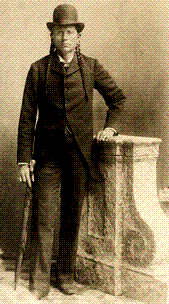
          Quanah Parker lived until 1911. He had five wives and 25 children. After his father's death he became a great warrior and a great chief in his own right. He led the largest band of Comanche to remain free until in 1875, he was finally defeated at the Battle of Palo Duro Canyon. Soon after he and his his warriors surrendered and were forced to go to the Comanche reservation in southeastern Oklahoma where he was chosen chief over all the Comanche.

          Once in Indian Territory, Quanah Parker adapted well to the white culture. He took his mother's surname of Parker, and became a successful rancher. He included among his friends Theodore Roosevelt. He rode in Roosevelt's inaugural parade and Roosevelt visited Parker at his home in Oklahoma where they went hunting together.

          Quanah Parker was loyal to his Indian heritage. He helped found the Native American Church, an attempt to join together Christian and Indian traditions. Quanah was also loyal to his family. He became acquainted with his white family and before his death retrieved the remains of his mother and sister, and buried them near his home in Oklahoma.  


                                                      Quanah Parker