Showing posts with label Texas. Show all posts

Friday, May 13, 2011

The Pauls in Texas

Well, I'm back from Texas. I got to see several of my cousins, one whom I haven't seen since he retired to Austin a couple of years ago, one from Arkansas who came down for the rodeo, and two in Del Rio, whom I saw as a child, but before I was old enough to remember.
                

                                Grandmother's Couch - 1900

I am an only child and I guess my cousins mean more to me because of that. Steve, my cousin in Austin, is more like a brother to me than he is a cousin. I grew up in Oklahoma and he in Texas but we still managed to spend a lot of time together. It was good to visit with him and his wife, their daughter and grandkids. They have another daughter who lives in Dallas. My cousin Steve has my grandmother's living room furniture, and also a clock our grandparents were given as a wedding gift in 1898. Steve's mother, Aunt Oteka, got the clock running again and Steve told me that when he was in high school he had to be in by the time the clock struck 10:00 P.M. He didn't always make it in time.
                        

                              Grandmother's Clock - 1898

After visiting and having some good Texas Bar BQ, we drove over to Del Rio to see the cousins I haven't seen since the late '40's. As I drove to Del Rio through San Antonio, childhood memories of the Alamo and the Buckhorn Saloon came back to me. As we drove through the desert, I remembered Steve showing me the surprising variety of cactus which live there. As we crossed the Nueces River, a major landmark, and at one time the southern border of Texas, I noticed that it was dry, as usual.

Steve had told me that once during a visit with Uncle Bob at his ranch near Bracketville, they passed a car sitting down in the river bed. Uncle Bob hooked a rope to the bumper and pulled it out, so that it wouldn't be in the river bed when the rains came. Steve said that the next time they passed by, the car was back in the river bed. Someone had put it there hoping to collect on the insurance.

I remember visiting my Uncle Bob, father of my Del Rio cousins, in 1954. He was separated from his wife at the time, so I didn't get to meet my cousins then. He was leasing a sheep and goat ranch. His yard was full of goats being treated for "screw worms," maggots which hatch from eggs laid by flies in sores they get from brushing up against the barbed wire. I remember how the goats climbed on our car to reach the tender mesquite leaves growing on the tree above it. They looked like school kids in a play ground sliding down the front windshield of our car as their companions crowded them off the roof. We had to have our car repainted when we got home.

                                      Texas Goats - 1954


                                   John Nance Garner


On the way to Del Rio, we passed through Uvalde, home of "Cactus Jack" Garner, the Vice President under FDR who famously said of his job, "It's not worth a bucket of warm piss." My Uncle Haskell, who came down to Texas about that time to help Uncle Bob negotiate the terms of his divorce - they were both attorneys - visited John Garner. Garner was retired at the time and was just sitting out in his yard when Uncle Haskell came by. According to the story we heard, they had a nice talk until Garner started bragging about Texas pecans. Uncle Haskell couldn't let that pass, and he told Garner that he had documented proof from "experts" that the Oklahoma "Native Pecan" was the most flavorful of nuts. Anyway, the argument ended their conversation. I guess we're lucky that Uncle Haskell didn't get arrested by the Texas Rangers for offending the honor of a Texas icon.
                               

                                          Haskell Paul

Del Rio is a pretty good sized town, compared to when I visited in 1954. It has a college, a truck driver school, and an Air Force Base, not to mention the George Paul Memorial Bull Riding. My cousin Homer was there. He is the manager of recruiting for the U. S. Express Trucking Company, which is a sponsor of the rodeo. He had one of the company's eighteen wheelers parked at the gate to the arena.


                                             U. S. Express

After we checked in at our hotel my cousin Bobby came by. I didn't know him since we haven't seen each other as adults. I was in the Hotel lobby waiting for him to arrive and when he stepped out of his truck he was so buffed that I walked back and sat down, thinking that he was one of the rodeo contestants. When he took off his hat I realized who it was. He looks like his dad. I guess that riding and roping keeps you in shape. Actually he reminded me of his brother George. George's upper body - his arms and shoulders - were really well developed. Anyway there aren't many 65 year old men with bodies like that.

Bobby told us about his family. His younger brother Lee died four years ago of a heart attack. His younger sister Betty is married and lives in Del Rio. His wife suffered a stroke a couple of years ago and is pretty much home bound. He has three children who are grown and were in town for the Bull Riding. Apparently the annual memorial to George was Lee's idea, but Bobby now runs it. It has been going on for 34 years!

The George Paul Memorial Bull Riding is about the most important bull riding event in the country, except for the National Finals Rodeo. It attracts riders from all over the U.S.A., Mexico, and even Brazil. There were 40 entrants this year, including four world champions and two former George Paul champions. The event will be televised later this month. Bobby spends most of the year managing the family ranch in Mexico. He told me about the dangers of the Mexican gangs, about how many people are killed each year, and how helpless is law enforcement.

I got to spend quite a bit of time with my cousin Homer. He and his dad and brothers were really good to visit my mother after my dad died. It's been a while since I've seen him. I felt out of place wearing a baseball cap, sneakers and wrinkled jeans. In rodeo country a cowboy hat, boots and pressed jeans is proper attire. Homer, my wife Sarah and I went out to the arena and took some pictures. We met Bobby's daughter Jaqui who was there helping out. We took pictures of the bulls being herded into the pins in preparation for the rodeo, the extra stadium seats set up just for the event, the big screen for instant replay. 


                                    Homer and Jaqui

My wife and I had supper with my cousin Betty and her husband that evening. Betty talked about her dad and how she enjoyed visiting him at his ranch when she was little and how they were all able to get together with him before he died. Divorce is a terrible thing for a family. She talked about how her brother George's death hurt her, and how much it meant to her for the town of Del Rio to support his memorial. The week before the George Paul Memorial Bull Riding are now called "George Paul Days" and are celebrated by a barbeque, a picnic, an art fair and other parties.

        
                                           Betty and John

I also got to meet Bobby's son Robert and his sister Elizabeth. I told them a little about some of the family history they don't know. Their great grandfather rode in rodeos back in 1898. He was a roper.


                                                 Robert and Me


                               Rodeo Contestants, about 1898.
                 Our Grandfather, W. H. Paul, second from right

The George Paul Memorial Bull Riding was spectacular. Out of the 40 contestants, only 15 stayed on their bull for the required 8 seconds during the first round, and only 4 during the second. It's hard to imagine how George managed to qualify on 79 bulls in a row! The bulls are ferocious. It's incredible how an animal that large can move so quickly. They jump three or four feet in the air, twist one way and then turn back unpredictably. If the rider gets turned to one side or slips back on the bull's rump, he's down, and if he get's thrown forward he can fall against the bull's head or horns - that's how George got thrown off the 80th bull in his string. He was thrown forward and was knocked out against the bull's head. Riders are frequently stepped on, kicked, or gored after they fall, in spite of the efforts of the "bull fighters," who try to distract and to draw the bulls away from them. It's a rough sport.


                            J. W. Harris - Leader after first day

There's a lot more to tell, just mundane stuff. I bought a cowboy hat; I resolved to have my jeans pressed the next time I visit Del Rio; I bought some prickly pear cactus preserves, and I took pictures of the Bull Riding honoring my cousin George. I wish I could have been closer to my cousins over the years. I guess I'm becoming one of these genealogy buffs. When I was younger I was too busy making a living to think about making connections with my family. Maybe it's too late to be close, but I am proud of them; I'm interested in their stories, and I want to make an effort to write things down so my kids and my cousins' kids can know who they are, and where they came from.

Friday, March 25, 2011

The Comanche, 1858

          As I described in my post of March 15, the situation for the plains Indians changed rapidly during the 1840's and '50's. Their profitable trade in horses stolen from Texas settlements was virtually halted by the admission of Texas to the Union, and by the United States' victory over Mexico, which had been subsidizing their raids. Their hunting lands were rapidly diminishing with the immigration of the Indian settlers from the southwest. The discovery of Gold in California was attracting thousands of settlers to cross the Indians' land, and the slaughter of buffalo for fur, for meat and just for sport, was eliminating their main source of food, clothing and shelter. They had sought advice from the eastern tribes, the so called Five Civilized Tribes, who had told them to give up their nomadic life and to settle down on farms.

          There was a drought in 1854 and it was especially hard on the plains tribes. In March of 1855, 4000 were starving in camps west of the Creek settlements on the Arkansas River. The Comanche Chief Tibbalo came to the Creeks for assistance. He said that he had seen how prosperous they were on their farms, and he asked them to intercede for him with the United States' officials to obtain land for his tribe.

          The Creeks took Chief Tibbalo to Fort Smith where he delivered his request. Jefferson Davis, the Secretary of War, recommended that the Department of the Interior set aside land as a home for the plains tribes, and so the department negotiated a treaty with the Chickasaws and Choctaws to lease part of their land for this purpose. In spite of this agreement, raids into Texas by bands of Comanches and other tribes continued, sometimes by Indians living on reservations in Indian Territory. 

          The Texans had given up negotiating with Indians, and they had given up deciding which Indians were their friends and which foes. They just wanted them out of Texas. In 1858, Texas requested the permission of Congress to pursue horse thieves into Indian Territory. Their request was denied but in May of 1858 a unit of Texas Rangers under John S. Ford crossed the Red River into the Wichita Mountains anyway. When he came across a Comanche camp whose warriors were out hunting, he attacked, killing 76 men women and children. He took several prisoners and 300 horses. Among those killed was Iron Jacket, grandfather of Quanah Parker. (See post of Feb. 20, 2011)    

          This indiscriminate attack by the Texans enraged the Comanche. They had pursued Ford's force and recognized among them a Keechi warrior whom they had seen living with the Wichita, so they assumed that the Wichita had sided with the Texans against them. As a result, the Comanche began to steal horses from the Wichita, as well as from Chickasaw and Choctaw settlers, to prepare for war against the Texans.

          In April of 1858 when the troops stationed in Indian Territory were ordered to Utah to confront the Mormons (see post of March 19, 2011) the Comanche saw their opportunity. They began planning an attack on Fort Arbuckle, in order to obtain its store of guns, ammunition and other supplies. Smith and Ellen Paul, my great great grandparents, lived right next to the fort, now defended by only five soldiers.   

To be continued.

Tuesday, March 15, 2011

Changes in Indian Territory Brought About by the Mexican War and the Gold Rush.

          The following is just a little bit of historical information about the changes that went on after my great great grandparents were married in 1844. It was a time of change, and the Chickasaws were right in the middle of it. I don't have too much specific information about Smith and Ellen's lives during that time. I do know that they moved twice. In 1846 they moved nearer to Fort Washita for protection, and in 1851 they moved next to the newly constructed Fort Arbuckle which was located in the middle of the Chickasaw district and in the middle of the fertile Washita River valley. In spite of the protection offered by the forts, Smith and Ellen still faced repeated raids by plains Indian tribes, and in spite of that harassment they managed to have three children, my great grandfather Sam Paul, born in 1845, my great aunt Mississippia, and my great uncle Jessie.

          In 1846 the United States admitted Texas to the Union, and sent out an army under Zachary Taylor to guard the southern border. Taylor's troops went to the Rio Grande River, and were attacked by the Mexican army, who believed that the border should be further north, at the Nueces. Thus began the Mexican American War. As General Taylor fought his way down through Mexico, the U.S. Navy blockaded the coast, and General Winfield Scott landed at Veracruz. In 1847, Scott's troops occupied Mexico City, and in 1848 President Polk forced the Mexican government to cede all of their territory north of the Rio Grande River to the United States. The U. S. paid only $18 million. The area included, in addition to Texas, the present states of California, Nevada, Utah, New Mexico, Arizona, Colorado, and parts of Oklahoma, Kansas, and Wyoming. It was a better deal then the Louisiana Purchase.

          The Mexican American War was a turning point for the plains Indians. During the previous decade the Texans had been systematically driving Indians out of their republic, and Mexican agents had been backing Indian raids on Texas settlements. The Mexicans had also spread the rumor that the Americans were planning to build a big town on the Canadian River, and to kill all the buffalo, a story that would prove to be close to the truth. Now the hated Texans were a part of the United States, and there was no longer any barrier to the westward expansion of American settlers. American agents were now trying to negotiate with the plains tribes for the safety of travelers on the Santa Fe Trail.

          Two of the fiercest tribes on the plains were the Comanche and the Osage. They had joined in a peaceful alliance together after signing a treaty brokered by the United States in 1835. The treaty was supposed to guarantee safety for the immigrant tribes, but the Comanche and Osage took advantage of their alliance to steal horses from Texas. The Comanche would steal the horses, and the Osage would exchange guns and other supplies for them. Both tribes attacked travelers on the Santa Fe Trail. Without Mexican support, their system was breaking down, and they were also losing the buffalo, which they still relied on for food, clothing, and shelter. The Osage and Comanche both turned to the Five Civilized Tribes for advice.

          In 1849, Oh-he-wek-kee nephew of chief Tab-a-que-na of the Comanche, who had signed the treaty of 1835, sought out John Jumper, chief of the Seminoles, and also Wild Cat, their speaker. Jumper and Wild Cat were sympathetic with the Comanche's plight, having suffered at the hands of the Americans in Florida, but they knew that it was futile to fight. Wild Cat advised the chief to make peace, to settle down, and to raise corn and cattle. Oh-he-wek-kee also visited the Creek chiefs who gave him the same advice.

          In 1848, after the death of Black Dog, the great Osage Chief, the tribe split into two groups, one led by a young warrior called "The Wolf," and the other led by Black Dog's son, "Young Black Dog." The Wolf came to see John Ross, Chief of the Cherokee, to ask for advice. Ross informed him of the Americans' victory over the Mexicans, and he counseled him to settle down and make peace with the whites. Wolf's group followed Ross' advice, settled among the Cherokee, and took up farming. Young Black Dog's group continued to live as buffalo hunters.

          During the early 1800's many of the plains tribes had become fragmented into independent bands, so in spite of treaties, conferences and decisions on the part of some leaders, there were still plenty of raids on Chickasaw settlements. That is why my great great grandparents had to live near a fort.

          In 1848, not did the U. S. acquire Texas and the Mexican territory west to the Pacific, gold was also discovered in California. Soon thousands of settlers were heading south to Texas and west to California. Also trade through Santa Fe had grown to $2 million per year by 1854. All three trails went through Indian Territory, so the Chickasaws became innkeepers again, just like they had been in Mississippi along the Natchez Trace. Suddenly there was a market for their services and for their produce.

          The Gold Rush was good for the Chickasaws in another way too. It provided the political pressure for the building of another fort further west to protect the travelers. Fort Arbuckle was built in 1851 further up the Washita River, right in the middle of the Chickasaw domain. Smith and Ellen moved there right away, and they were followed by other Chickasaw families. In 1844 only 25% of the Chickasaws lived in their own district. In 1853 the figure was 90%.

Tuesday, March 8, 2011

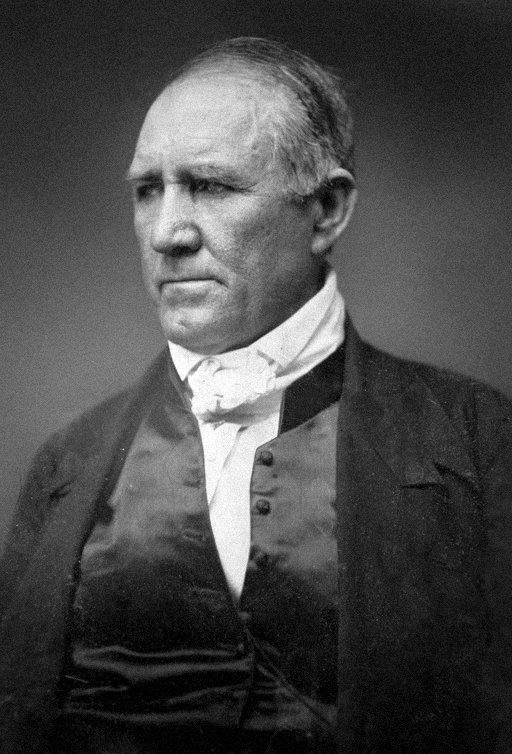
Sam Houston, Co-lon-neh

      File:SHouston 2.jpg

          I enjoyed Tom Brokaw's book, The Greatest Generation, about my parents' generation. Those who lived through the Depression and then fought in World War II were special, but after learning about the people of the early 19th century, I think a better name for Brokaw's book would be "The Greatest Recent Generation." The people of the early 19th century were also a cut above those who followed them. Their courage and self confidence created the world we live in, and in that time of strong men and strong personalities, Sam Houston stands out as one of the strongest.

          Sam Houston was born in Kentucky in 1793. His father died when he was 14, and his mother took him and her 8 other children to a homestead in Tennessee, where she managed a farm and a store. Sam didn't like farm work so he was put to work in the store. Soon tiring of that, he ran away and joined a band of Cherokee Indians, like my great great grandfather Smith Paul. Houston later commented that he preferred the freedom of the Indians to the tyranny of his brothers.

          In his autobiography, Sam Houston describes with great respect the simplicity and virtue of the Cherokee. He learned the Cherokee language and was adopted by their chief, Oo-loo-te-ka, who gave Sam the name Co-lon-neh, the Raven. After three years with the Cherokee Sam returned to his home, and for a while worked as a teacher.

          Houston tried for a while to further his education, but failing geometry he joined the Tennessee militia under Andrew Jackson. He joined just in time to take part in Jackson's massacre of the Creek Red Sticks at Horseshoe Bend in 1814 (see post of October 26, 2010). Unlike David Crockett, who was disgusted by the senseless slaughter, Houston was caught up in the excitement. When the first man over the breast works was shot in the head, Houston followed him and was shot with an arrow in the leg. When the arrow was removed Houston said he was ready to return to the battle. Andrew Jackson himself ordered him to remain in the rear, but Houston not only disobeyed Jackson's order, he volunteered to lead the charge against the Creeks' last bastion. He was shot twice in the shoulder, and then led the charge again. Houston survived in spite of his serious wounds, and his reckless heroism earned Jackson's respect.

          Sam Houston returned home after the Battle of Horseshoe Bend, where he was nursed back to health by his mother. As soon as he was strong enough to ride a horse he went to Washington, DC, and asked to be commissioned into the army. Before he left Tennessee, his mother gave him a ring on which was engraved the word "honor." He wore the ring until his death. After a brief service in New Orleans at the end of the War of 1812 Houston was appointed Cherokee agent. He was able to convince his Cherokee "father," Oo-loo-te-ka or John Jolly, as he was known to white men, to move west to the Indian Territory with his followers. When the guns and blankets that were promised to the Indians weren't delivered, Houston led a group of Cherokees to Washington to complain. When he confronted John Calhoun, the secretary of War, Houston dressed as an Indian, in a blanket and a breechclout. Calhoun reprimanded him for not wearing his military uniform, and accused him of slave trading. Houston resigned his commission.

          Now unemployed, Houston decided to return to Tennessee and to become a lawyer. He may have failed at geometry, but he had always been an avid reader. Houston began to "read" the law in the office of James Trimble in Nashville, Tennessee, and after six months he passed the bar and set up his own law office in Lebanon, Tennessee. There he became a regular visitor of Andrew Jackson who was at home recovering from his own wounds. In Lebanon, Houston ran for the office of prosecuting attorney and won.

          Houston rose quickly in politics. He was elected Major General of the Tennessee militia and then senator. During his term in Congress he was involved in several conflicts including a duel. To remind John Calhoun, still secretary of War, of his previous insult, Houston presented him with a bill for $36 for his expenses as Cherokee agent. After his term in the Senate Houston returned to Tennessee, ran for governor, and won.

          Then something happened for which there has never been a satisfactory explanation. Near the end of his term as governor, Houston married a young woman named Eliza Allen. Three months later he resigned as governor and boarded a steamship for Indian Territory with no other explanation than Eliza had been cold to him.

          Once in Indian Territory, Houston rejoined his Cherokee father John Jolly, and began to drink heavily. Houston's friend Andrew Jackson was now president and Houston began writing letters to him complaining that the Indian agents were cheating the Cherokee out of their annuities, and white settlers were cheating them out of their land. He also was heard to boast that within two years he would conquer Mexico and become emperor of Texas. This sounds a little crazy, even for Sam Houston, but apparently Jackson took him seriously because he shot back a letter asking him not to go ahead with his plan.

          In Indian Territory Houston built a home he called his "wigwam;" he opened a trading post and married a Cherokee woman. In 1829 he became a member of the Cherokee tribe and made a trip to Washington as part of a Cherokee delegation. While he was there he was invited to the White House to visit Andrew Jackson. After recommending to Jackson's Secretary of War, John Eaton, that he fire several Indian agents, he submitted a contract to provide rations for the Removal of the Five Civilized Tribes to Indian Territory. Houston was not awarded the contract, and he returned to his home among the Cherokees.

          While operating his trading post, Houston was investigated by the commanding officer at Fort Gibson, Colonel Matthew Arbuckle, for selling liquor to the Indians, which was illegal. Houston himself had protested to Washington about the illegal liquor traffic to Indian Territory and its damaging effects among the Indians. When confronted with the enormous amount of liquor that he had purchased, Houston swore that all of it was for his personal use. Perhaps he was telling the truth. The Indians had given him a new name, it meant "big drunk" in Cherokee.

          Houston led another Cherokee delegation to Washington in 1831. While he was there William Stanberry of Ohio accused John Eaton of conspiring to give Houston the contract to provide rations for the Removal. Houston challenged Stanberry to a duel, and when Stanberry didn't reply, Houston caught him on the street and beat him with his cane. Houston was six feet six and still a formidable man, in spite of his war injuries. Houston was put on trial by Congress for his attack. The trial lasted for a month and Houston was defended by Francis Scott Key. On the night before the trial's conclusion Houston went out and got drunk, then went to Congress the next morning and in spite of his hangover gave an eloquent speech in his own defense. Congress let Houston off with a $500 fine.

          In 1831, one of the issues which attracted attention in the United States was Texas. After Mexico had won their independence from Spain they had been inviting Americans to come to Texas to settle. The number of settlers had grown to 20,000. The Texans were more loyal to the United States than they were to Mexico and there was much sentiment there for independence. Jackson had made some diplomatic efforts to buy Texas from Mexico but had been rebuffed. While Sam Houston was in Washington going through his spectacular trial, he had also been visiting the President, and they had talked about Texas. There's no record of whether they discussed Houston going to Texas, but this time when Sam Houston left Washington, he didn't return to Indian Territory. He went to Texas and joined a settlement headed by Steven F Austin, apparently deserting his Cherokee wife.

          I think I'll skim over the details of Sam Houston's adventures in Texas. That part of his story is Texas history. He helped inspire Texas' fight for independence; he proved to be a shrewd general in his defeat of Santa Anna at San Jacinto, and when Texas became a republic in 1836, he was elected president. When Texas became a state of the Union, Houston served as a senator and also as governor. When Texas voted to join the confederacy, Houston resigned his position as governor and retired to private life, refusing to fight against the Union. Sam Houston continued to be a colorful character. He never gave up his independent spirit and he was always a friend of the Cherokees.

          Sam Houston made his home in Natchidoches, Texas, close to a peaceful settlement of his old friends, the Cherokees. There was a terrible prejudice among the Texans against Indians, because of the depredations made against them by the plains tribes. It didn't matter to them whether or not the Indians had taken up civilized ways; it didn't matter to them whether or not they were living peacefully with their neighbors. In 1836, Sam Houston went out to Bowles Village, named after the Cherokee leader who had sought safety for his people in Texas twenty years before, and he made a treaty guaranteeing the Cherokees safety on the land that they occupied. In 1837 the Texas legislature refused to ratify the treaty, and in 1839 after Sam Houston had been replaced as President by Mirabeau Lamar, several regiments of Texas militia fell on the 1500 peaceful Cherokees and drove them out of Texas. After all his many accomplishments Houston couldn't protect his lifelong friends, the Cherokees.
Advancing the Frontier, Forman, P 165.

          After I wrote the above summary of Sam Houston's escapades I began to doubt whether it belongs with a group of stories which try to look at history from the Native American point of view. I had first thought of putting it in because Houston's story has always been entertaining to me. He went recklessly from one adventure to another during his life, and he had the strength, the raw courage, and the intelligence to survive, even to succeed.

          But something about the story of Sam Houston bothers me, and maybe it's because his personality highlights the attitudes of the white America of his day. On the one hand he appreciated the Indians' "simplicity." That was the same kind of grudging admiration that was given to blacks at the time. Houston was taken in and protected by the Cherokees as a rebellious teenager, and then proudly took part in the greatest slaughter of Indians in the history of this country. Later when Houston was having marital problems he turned to the Cherokees again, and to alcohol. As the "big drunk" he showed off his celebrity by taking them to Washington, where he tried to take advantage of their misfortune by applying for a contract to provide rations for the Removal, which was second only to the slavery system as the greatest travesty of human rights in our country's history. Then as soon as he got an opportunity for glory in Texas, he abandoned his Indian wife without a second thought.

          I'm not saying that Sam Houston wasn't sincere in his gratitude and admiration for the Cherokee, and I am still entertained by his story, but perhaps the appeal of Sam Houston can give us a little insight into how such men could become heroes in their time, and how such attitudes could be rationalized.
 

Saturday, February 12, 2011

Nadua, Cynthia Ann Parker


                                         Nadua, Cynthia Ann Parker

          In December of 1860 the Texas Rangers made a surprise attack on 20 Comanche Indians who they believed had been raiding settlements in the area.  As the Comanche fled, the Rangers cut them down. One woman carrying a baby was spared. Her name was Nadua. Her husband was Peta Nocona, a great Comanche chief, and her son was Quanah Parker, the last chief of the Comanche.

          The relentless westward expansion of white settlers displaced, one by one, the Native American tribes from their homelands. Hundreds of tribes were crowded together onto land depleted of the game they depended on for survival. Relationships between tribal groups that had developed over centuries were disrupted, leading to wars among the tribes. An endless series of broken promises convinced the Indians that the word of the white man could not be trusted. Native Americans dealt with their dilemma in various ways: by trying to adopt the white man's ways, by trying to escape by moving further west, and by retaliation. The Comanche chose the latter.

          During the 1830's the Comanche lead an effort to create an Indian alliance, as had the Shawnee chief Tecumseh and the Sauk chief Black Hawk. One of the leaders of this movement was Nadua's husband Peta Nocona. Peta was the son of another Comanche chief, Iron Jacket, of whom it was said he could blow bullets away with his breath.

          In 1833, a white settler named John Parker brought his family down from Illinois to east Texas. He built a fort, made friends with some of the local Indian Tribes, and began farming. What he didn't realize was that he had settled in Comanche country. In 1836, a band of Comanche, led by Chief Nocona, attacked the Parker settlement. Five men were killed, and six women and children were taken hostage.

          Among the hostages were Cynthia Ann Parker, age 9, and her brother John, age 5. Eventually all the hostages were ransomed except for Cynthia Ann, who was given the name Nadua, 'someone found,' in the Comanche language. Chief Nocona married Nadua, and they had three children together: two boys Quanah (Fragrance) and Pecos (Pecan), and a girl Topsanna (Prairie Flower). Nocona's affection for Nadua was so great that he never took another wife unlike most chiefs of his rank.

          At the time of the 1860 attack on Chief Nocona's band, the chief and his son Quanah were away hunting. Sull Ross, commander of the Texas Ranger unit which massacred the little group of Comanches, claimed to have killed Chief Nocona. Ross made a lot of his victory over the little band of Comanches, claiming that it put an end to the "great Comanche confederacy." It earned him the notoriety that later got him elected Governor or Texas.

          The other claim made by Ross was that he had rescued the long lost captive of the Comanche, Cynthia Ann Parker. Soon after Nadua's capture by Ross, one of his men noticed that her eyes were blue. After much questioning Ross managed to connect Nadua, who had forgotten how to speak English, with the Fort Parker massacre 25 years before. Nadua was returned to her white family, and when her uncle Isaac Parker mentioned that his niece Cythia had been captured by the Comanches, Nadua said: "me Cincee Ann." Although her family tried to make her feel at home, Nadua begged them to let her rejoin her Indian family, and she tried several times to escape. Four years after her capture, Nadua's daughter Prairie Flower died of pneumonia. After that Nadua stopped eating and soon she sickened and died.

          Nadua's husband Nocona also died soon after his wife and daughter were captured. According to his son Quanah he died of injuries he had sustained years before in a battle with the Apache.


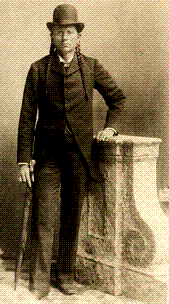
                                                  Quanah Parker

          Quanah Parker lived until 1911. He had five wives and 25 children. After his father's death he became a great warrior and a great chief in his own right. He led the largest band of Comanche to remain free until in 1875, he was finally defeated at the Battle of Palo Duro Canyon. Soon after he and his his warriors surrendered and were forced to go to the Comanche reservation in southeastern Oklahoma where he was chosen chief over all the Comanche.

          Once in Indian Territory, Quanah Parker adapted well to the white culture. He took his mother's surname of Parker, and became a successful rancher. He included among his friends Theodore Roosevelt. He rode in Roosevelt's inaugural parade and Roosevelt visited Parker at his home in Oklahoma where they went hunting together.

          Quanah Parker was loyal to his Indian heritage. He helped found the Native American Church, an attempt to join together Christian and Indian traditions. Quanah was also loyal to his family. He became acquainted with his white family and before his death retrieved the remains of his mother and sister, and buried them near his home in Oklahoma.  


                                                      Quanah Parker