Sunday, August 7, 2016

Oatmeal

My kids live in Spokane, Washington, so I don’t get to see them that often, or my grandkids either, so when I went up there for my granddaughter Alyssa’s graduation, it was a big deal for me. When I go I stay with each of my kids for a while, which is great, except for the grandchild who has to give up his or her bed for me to sleep in. Each visit is precious for me, and memorable, but one thing in particular touched me while I was staying with my son Donald, my daughter-in-law Tina, and my grandkids, Ciara, Lauren, Zach, Sophia, and Cody. Zachary’s the one who had to give up his bed. Thanks, Zach.

Anyway Donald’s a lawyer. He’s much better in every way than I am, but he does have one thing in common with me at his age.  He’s really busy. He gets up at the crack of dawn, and often works late and on weekends. In spite of this, he still manages to spend quality time with his family. When he’s there, he’s really there, hearing about the latest accomplishment or disappointment; playing games; helping Tina cook or clean up; running errands; organizing work details to get stuff done, and he fixes oatmeal for breakfast.

That’s what got to me. My mother used to fix oatmeal for breakfast. I can still remember the warmth and smell of it as I would stand on a stool by the stove, stirring it so it wouldn’t stick to the pan. Donald asked me to stir his oatmeal too. Well, anyway, to me oatmeal means love.

Thinking about oatmeal and love and old memories, reminded me of a letter my Grandmother wrote to me when I was four.

Dear Robin,
I received your Letter. & read every word that you wrote. When I got home it was past three in the morning, and I went out to see Spot. He came to the fence to look at me. Neither one of us spoke. Then I came in to see if I could find anything for him to eat & there wasn’t one scrap of anything so I cooked him some oat meal & took that to him & then when I came in he cried, so I brought him in & let him sleep in the rocking chair. I have a lot of flowers blooming & my place looks pretty. I took dinner with Phillip Sunday & I told him that you were coming to play with him. & he is looking forward to you coming. You write again soon.
Lodes & lodes of love. Grandmother


Spot was Grandmother’s dog, and Phillip was my cousin. She loved her dogs and her grandchildren. 


Grandmother and Spot


Phillip

Saturday, July 23, 2016

Hell's Hole

Apology

Hi everyone. I want to apologize for neglecting my blog for so long. I have really missed the connections it's allowed me to make, and also the feedback I get from people. 

I've been thinking for some time about making some changes to my blog's content. So far I've stuck pretty much to Native American and family history, but there are a lot of other things that interest me, so I think I'll try sometimes just writing about subjects that interest me at the moment. I enjoy music and hiking, for instance, and I also like to make observations about events in my daily life. 

There are still a lot of stories I need to record about our family, and I'm still trying to learn more about Native American history, especially Chickasaw history, so I'll continue with that, so for those of you who think the new blogs are silly, just be patient, because I'll continue with the old subjects as well.

I hope this is agreeable to most of you. It will make the content a little less predictable, but hopefully more interesting, and we'll get to know each other a little better, so here goes.

Hell’s Hole

The Hell’s Hole Trail is a pretty good hike. It is listed as 8.2 miles out and back, starting at 9700 feet and climbing up to the tree line at 11600 feet. The Alltrails website describes it as a moderate hike, but I wouldn’t recommend it for a novice, or for a tourist from sea level.

Last week I got an invitation from Jerry, a friend from the hiking club, to hike Hell’s Hole, but I was reluctant to go. It’s been several months since I’ve been hiking, and then only a couple of “moderate” hikes with my grandson during his spring break. Jerry and Mary, who also decided to go along, are experienced hikers, and I wasn’t sure I could keep up with them.

I’ve been having some doubts about my physical fitness anyway. I’m getting older, 74 last May. My knees hurt, and my back hurts, also my left shoulder, my neck, my wrists, and don’t get me started on my feet. Also, I don’t have the energy I used to have. Penny, our dog, has to practically turn cartwheels to get me to take her walking, and I can hardly get through the day without my afternoon nap, a definite sign of old age.

But, I decided to go anyway. I have always enjoyed hiking, so it should be fun, I thought, If I could just get myself out of bed. Jerry and Mary were leaving at 7:00 AM.

The night before the hike, I filled up my water bladder to its full three liter capacity – don’t want to run out of water - made myself a peanut butter and jelly sandwich, and then loaded up my pack: rope, goggles, first aid kit, bear spray, insect spray, big knife, little knife, flare, map, GPS, compass, warm stuff if I have to spend the night, parka in case it rains, head lamp in case it gets dark, and two little sacks of ‘it’s nice to have’ stuff, like fire starter, tweezers for when your fingers won’t untie a tight knot, toothbrush, eye drops, extra batteries, insect spray, pencil and paper. About the only thing I didn’t pack was my sleeping bag, air mattress, and tent – overkill, I figured. After packing up, I laid out my clothes, set my alarm for 5:30 AM, and went to sleep.

Next morning I was awakened by my wife Sarah, asking, “Aren’t you going hiking today?” I instantly came awake and turned toward the clock. Sure enough, it was already 7:00 AM. I picked up my cell phone and called Jerry. “No, don’t wait for me,” I said, “It will take me 30 minutes to get there. I’ll catch up with you,” knowing full well I’d never catch them, even if I could get started in 30 minutes, but I was determined to go anyway, so I threw on my hiking clothes, laced up my boots, and raced out the door.

The trail head for Hell’s Hole is about 8 miles south of Idaho Springs, a little mountain town about 50 miles from Denver on I-70, the main highway going west. The road to the trail head is pretty good, only dirt for the last 3 miles or so, and it ends at a series of camp sites. I stopped at the first one, jumped out of the car and grabbed my gear. Looking at my pack, I thought, that’s an awful lot to carry on an easy little day hike, so I tossed out everything but my water, my parka, my peanut butter sandwich, my map, and my bear spray - you never know - and took off down the trail, the wrong trail, as it turned out.

The path I chose crossed a stream and then crossed back again, headed west, but I decided to stay on the east side of the stream, Chicago Creek, knowing that the trail followed the creek. I had glanced at the map the night before, confirming the direction of the trail, so I was confident. After all I’d been there before, only my memory wasn’t as good as I thought. Hell’s Hole Trail doesn’t follow the stream as do most mountain trails. It goes along the ridge above the stream, way above!

The Hell’s Hole camp grounds are popular, I discovered, and the campers venture pretty far out into the woods, so as I walked along the trail, I continued to see camp sites for quite a while, reinforcing my belief that I was on the right trail. Before long, I did start to encounter fallen trees, not too unusual, but also new growth. “Boy, this trail needs some work,” I thought.

After a while I stopped seeing camp sites, and I began to lose the trail, also not unusual for me. I’m notorious for getting lost. It kept veering off toward the stream, and then I’d have to climb back up the hill until I found it again. This, as I eventually reasoned out, is what you’d expect from a game trail. Deer, elk, and moose wander around eating grass, and then go down to the stream to drink. But I was in a hurry, and by the time I figured out there were no people traiIs, I was already a mile or so in.

Now I want to reassure my hiking friends that I would never have continued on at this point if someone had been with me. I would never subject anyone else to the struggles and risks of bushwhacking, or blazing your own trail. It’s strenuous work, and a little dangerous too, venturing out into the wilderness, miles from any road or trail. 

On the other hand, it's kind of exciting, and challenging too, constantly facing new obstacles, a fallen tree, a rock slide, a dense thicket, or a marsh. It’s foolhardy, especially for an old man, but when I’m by myself, I kind of enjoy it. 

Getting around fallen trees and underbrush can be tough. Those pictures of Little Red Riding Hood skipping through the forest are totally wrong. A primal forest is almost impassable, and long pants are a must. Unfortunately my fancy zip on pant leg extenders were among the things I had removed to lighten my pack. I followed game trails as much as possible, but still came away with scrapes and bruises.   

Detouring around a fallen tree can take ten or fifteen minutes. I passed by several that had been wrenched out by the roots, raising a huge pan of soil and tangled roots ten or fifteen feet high on one end, and a tangle of branches extending out 100 feet or so on the other. Usually I tried to detour around the top of the tree or climb through the branches, but one I encountered was just too dense, so I decided to go around the upended root system, which hung out over the stream.

In the cavity where the tree roots had been, was a broad stretch of mud. I didn’t want to get muddy, but my boots don’t leak, so I figured the worse that could happen was that I’d walk around for a while in muddy boots. I was wrong. That wasn’t the worse that could happen. When I stepped out onto the mud, I instantly sank up to my knee in thick, black, muck. And then, when I tried to pull my foot out, it wouldn’t budge. I just managed to lose my balance and fall. So there I was, sitting in the water, with my left foot stuck in the mud. I suddenly knew how the saber toothed tigers felt when they got caught in the tar.

My right foot was on fairly solid ground, so I used it for leverage and gradually wrenched my left foot free, and then clambered up on the bank. After assessing the damage, I was disgusted with myself. Nothing’s worse than hiking on wet feet, and I had left my extra pair of socks in the car with my pant legs, so I just slogged on with a muddy boot.

The other two things I had to deal with while bushwhacking were boulder fields and willow thickets. Boulder fields are the result of rock slides, and are pretty frequent at the base of mountains, and willow thickets grow in any flat moist area next to a stream. Since my path lay between a mountain and a stream, I was constantly avoiding one or the other.

Boulder hopping is not a sport for old folks. Sometime between the ages of forty and seventy you lose your sense of balance, and there’s something disorienting about a pile of boulders. I can cross a stream pretty well by balancing on a log, even stepping on rocks, but boulders scare me. I hurt my back a couple of years ago when one rolled under my foot and caused me to fall. I didn’t hike again for about a year.

Anyway, when I cross a boulder field, I use a walking stick to try and create a stable base, and then choose a route that allows me to hold onto a rock with the other hand. I usually carry gloves for that, but – you guessed it – I left them in the car with my socks and pant legs.

Willow thickets were my other main obstacle. I don’t understand the botany, but willows seem to grow everywhere in the mountains. It must have something to do with elevation. They seem to like water, because every marsh is covered with them, but they grow up on the mountainside too, which doesn’t make any sense to me.

The thing about willows is they grow close together and their branches intertwine so you can’t walk between them. If you try to walk on them they aren’t sturdy enough to hold you, or to lean on, and there’s nothing firm to anchor a walking stick, so you – I - usually lose my balance and fall into the water. I do everything I can to avoid willow thickets.

After about four hours of bushwhacking I finally came to the tree line, about 11500 feet in this area. In the mountains, there’s a special meaning to that saying, “You can’t see the forest for the trees,” because it’s only when you get above the tree line that you can really see where you are, so when I got there I breathed a sigh of relief, and sat down to rest, have a drink, and assess my situation.

With the exception of a few scratches, I didn’t seem to have any major injuries. I hadn’t twisted my ankle or wrenched my back, and remarkably, the mud on my left shoe had dried and flaked off. When I removed the shoe I found that my left foot wasn’t even wet. I guess mud is better than water.

But as far as reorienting myself, I realized that I was still lost. All I could see were mountains in every direction, and nothing looked familiar. I knew that the Hell’s Hole Trail ended at the tree line, at a little lake fed by Chicago Creek, and since I was at the tree line just above Chicago Creek, I knew I must be close, but why couldn’t I see the lake? Trying to come up with a plan, I decided that the most sensible thing to do would be to just follow the creek back to the trail head, so I headed back into the trees, toward where I left the stream.

As I walked, I started to get second thoughts about bushwhacking for another four hours. I wasn’t especially tired, but climbing up and down, over rocks, through muck and dense thickets does get a little old after a while. I had also remembered by this time that the Hell’s Hole Trail follows the ridge above the creek, not the creek itself, so when I got to the creek, I crossed it and headed up, hoping to cross the trail, or at least climb high enough to see it.

Climbing above the tree line, I could see the mountains again, but I still couldn’t make out the trail. The only thing that seemed vaguely familiar was a cliff looming high above me. I kept thinking about it until suddenly it hit me. It was the cliff above Hell’s Hole. I had seen it before, but only from above. That meant that I was actually in Hell’s Hole. Now I understood where the name came from. The guy who named it must have spent the day bushwhacking like me.


Central Ridge, View from Hell's Hole


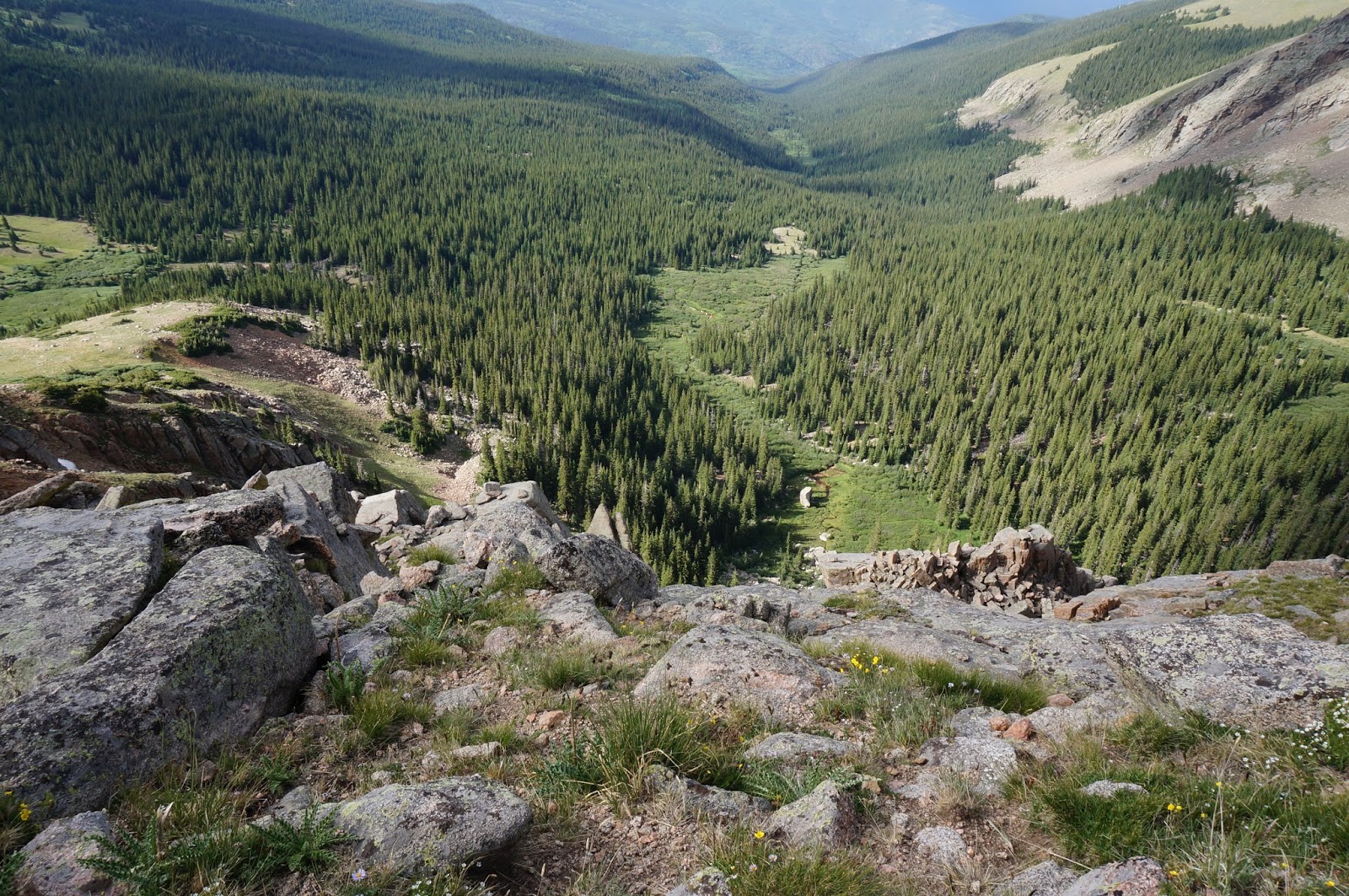
The Hell’s Hole Trail follows a ridge that forms the western border of a glacial valley where the Chicago Creek runs. The valley and the creek split into two branches at the tree line and end blindly, enclosed by steep mountain ridges. Although the trail ends at the tree line, I had hiked up to the top of the central ridge on two previous occasions. There you can see both arms of the glacial valley, as well as the Chicago Creek meandering back down to the Hell’s Hole trail head. I headed for the ridge. There I’d be able to see the lakes at the end of the trail and also take in the panorama.

Getting to the top of the ridge turned out to be more of a task than I anticipated.
Climbing above the tree line is slow going, not just because it’s uphill, but because there’s not as much oxygen up there, so it was take a step and breathe, take another step and breathe, and so on. It took me another three hours to climb to the top of the ridge, about 1000 feet elevation gain I figured out later. It was 4 o’clock in the afternoon before I got there.

Having reached the top of the ridge, I sat down, ate my peanut butter sandwich, and admired the scenery. Looking down, I now recognized the end of Hell’s Hole trail, 1000 feet below me. I could see the little lakes at the end of the trail, and the willows bordering the creek. I could even make out the trail itself, extending down to the north, along the ridge, and just 50 yards to my right was the cliff overlooking Hell’s Hole, which I had been climbing out of for the last three hours.

There’s nothing like being in the mountains. It’s so beautiful, and peaceful, and relaxing, and I was getting sleepy, so just like I do every day about 4:00 PM, I lay down and took a nap. It wasn’t a long nap. It’s hard to sleep with a rock pressing against your ribs, and my camera case didn’t make a very good pillow, but I made my concession to old age, and I did feel better afterwards.

I woke up looking at a very pretty and unusual crop of flowers. I’ve seen most of the flowers above the tree line, but this one was new to me, so I took some pictures. Then I called my wife Sarah, who’s used to my little escapades. Actually I had tried to call before, but couldn’t get any reception. After explaining to her that I had gotten off the trail and might be in a little late, she just replied, “Quit lollygagging, and come home.”


Mountain Avens


I called Jerry too, who I figured was wondering why he hadn’t passed me on the trail, and left a message for him not to worry, that I would be just a little late, and that I would call him when I got down. Then I went over to the cliff overlooking Hell’s Hole, took some pictures, and then started down towards the trail.


Hell's Hole, as Viewed from Ridge


It was about 6:00 when Jerry called me back. He had gotten back to Idaho Springs and was getting phone reception. He warned me to stay on the trail in case I had to be rescued, and “Do you have a head lamp? It might be dark by the time you get down.”

“Oh, yes, of course,” I replied, lying through my teeth, knowing that I had left my headlamp back at the car with all the other stuff I didn’t want to carry. Uh Oh, I thought, there’s another problem. The forest is always dark at night, even with clear skies, and I’m clumsy enough in good light, so I began to pick up my pace. I didn’t want to get caught out on the trail after dark.

I still had to cross a marsh to get to the trail, and pick my way through another willow thicket. I did have a slight advantage this time since I was coming down from above and could plan my route, so I made it through without hitting too many blind ends, or falling into the water.

It felt so good when I finally got back on the trail. It was rocky, but easy compared to any path I had taken all day, and I was able to speed up. In fact, I jogged most of the way back, and reached the trail head in only two hours, about 30 minutes before sundown. I felt pretty good too. I was a little sore, but no more than usual after a hike, and my muscles hadn’t cramped up. When I got into Idaho Springs, I called Sarah and Jerry, and then treated myself to a greasy bacon burger and a root beer.

My little adventure lasted a total of 11 hours, hiking probably twelve miles, with a net altitude gain of 2800 feet, from 9700 to 11500 feet, and down again, and I probably spent 7 hours and 1000 feet of it "lollygagging" as Sarah would say. It’s now a new day, and I still feel pretty good. I took Penny for a walk and I’m starting to feel a little sleepy. Think I’ll take a nap. 


Saturday, February 27, 2016

Between Battles


Seaman First Class Everett Gunning 


My dad wrote to Everett every week, and Everett wrote back almost as often, although his letters were censored and didn't include any information about the fighting.

Here’s one written just before the Battle of Cape Esperance:

10/1/1942
Dear Don,
You and Mother are the only ones I have heard from for a long time. You and Mother tell me all the news. There is so little I can write in answer. I guess only my real friends answer. My girl in San Francisco, California is the only one I miss hearing from. A friend of mine, who has seen Jean since I left says she still loves me, but I may need Jimmy’s mother to get me an Indian girl. They are my weakness anyway.
I made Seaman 1st Class finally. That is the best news I have had for some time. I am studying for something else now.
Your Bud, Everett.

Everett was obviously homesick but he was also caught up in the excitement of his adventures. The Enid Daily Eagle, Everett’s hometown paper, reported:

Gunning wrote that he certainly would like to spend the holidays at home with his parents at Enid. Pearl Harbor precluded that. Then he wrote again that he regretted the fact that he had missed spending the last two Christmas seasons with his folks “but will see you next Christmas if I have to whip the Japs first…. If I could get home for a visit then I would be ready to go to Tokyo.”

While Everett was dodging bullets on the high seas, Boyd was still training in jungle warfare in Hawaii. He wrote to my parents about the beautiful orchids there:

10/25/42: Dear Don,
Your letter came per today and it is good to know that your family is all well and that you are still turning them out (He means the B17 bombers). Give Jimmy and Robin my best regards, and tell Jim that I would like to pin some of these natural plentiful orchids on her with my compliments. They had the annual orchid show in Honolulu this week but I didn’t get a chance to go. I would like to see you all - and especially that Robin. If you are taking any snap shots send me one occasionally. I may get a chance to show them to Everett. I worried about him for a while but know he is okay now, and expect to see him one of these days. Write him that I would like to hear from him. Work hard, you are in the best spot in the world and I’m counting on you. If you go to Norman spend some time with El and the boys. They are lonesome at times and would be glad to have you. I’m fine and don’t expect to spend all my life or even the best part of it here.
Sincerely Boyd

Ironically, Boyd’s comment about being relieved that Everett was okay was written just two weeks after the Battle of Cape Esperance and a little over two weeks before the Battle of Guadalcanal, when Everett narrowly escaped being killed.

Shortly after the Battle of Cape Esperance, Everett had another close call. As the San Francisco was cruising back to port, one of her sailors spotted a torpedo heading straight for the ship. Word of the sighting was quickly passed up to the bridge where the pilot turned the ship away in time to avoid being hit, but one of the other cruisers, the Chester, was not so lucky. She was struck and badly damaged.

Everett told another story about being attacked by Japanese bombers. I’m not sure when it was. He said they were escorting a convoy at the time, so it could have been during the battle when the carrier Wasp was sunk, or following the Battle of Cape Esperance. The episode was reported in a newspaper article written while Everett was home on leave in December of 1942:

While in the Solomons, the San Francisco was in a battle, along with some other American vessels which had convoyed a group of transports with supplies for the men there, with 17 huge Jap bombers, carrying torpedoes. The San Francisco did something which no other ship has ever done - shoot down a bomber with their big guns. (Everett said) “When the shell hit that bomber it blew into bits. That scared the Japs so bad they dropped their eggs harmlessly and ran.”

The Battle of Cape Esperance had been an empty victory. As Admiral Scott retreated with most of his task force to the American base at Noumea, the destroyer McCalla stayed behind to rescue the survivors. Many of the men from the sunken destroyer Duncan drowned or were eaten by sharks during the night. As for the Japanese survivors, many drowned because they refused to grasp the ropes thrown to them by American sailors, a grisly scene for the sailors who witnessed it.

Shortly after the battle, the Tokyo Express resumed, bringing more supplies and men down the “slot” to reinforce the Japanese forces on Guadalcanal. By late October the Japanese were ready, and three units marched through the jungle and surrounded the US marines defending Henderson Field. On October 23 and again on the 24th, wave after wave of Japanese soldiers ran across the Matanikau river to the north and across what came to be known as “bloody ridge” to the south screaming “banzai” and “death to Americans.” The American troops were terrified but ready. 3500 Japanese troops were killed in the desperate attempt to overrun the American base, compared to American losses of 200.

Meanwhile a Japanese carrier group waited near the Santa Cruz Islands east of Guadalcanal ready to land planes on Henderson Field after their infantry had overrun the marines. They were unable to take Henderson Field, but they did find and attack two US carriers, the Hornet and the Enterprise, sinking the Hornet and two US destroyers while suffering only minor damage to their own ships.

By this time the struggle for Guadalcanal had become famous. Several reporters had landed with the troops, and their hair raising reports of the marines' brave defense of the little airstrip there catapulted the struggle into a national issue. President Roosevelt himself told the admirals of CINCPAC to make sure the troops on Guadalcanal got everything they needed. Admiral Halsey, who had taken over command of the South Pacific theater from the indecisive Admiral Ghormley, told the marine General Vandergrift, “I’ll promise you everything I’ve got.” 

Meanwhile, Everett’s ship, the USS San Francisco, was taking on supplies at Noumea, New Caledonia, getting ready to return to action.


Saturday, January 30, 2016

The Battle of Cape Esperance


Early in World War II, Japanese forces were superior to the Americans in almost every way. In the air, the Japanese Zero fighters were faster and more maneuverable than the US Wildcats and P-40's which protected Guadalcanal, so that the US planes had to be continually replaced. The American pilots also had to be replaced on an average of every thirty days. The jungle took its toll in dysentery and malaria, as did the stress of constant bombardment, and a shortage of fuel and ammunition. On the sea, the Japanese torpedoes were more accurate, and all their ships carried them, whereas the US torpedoes exploded only about half the time and only destroyers carried them. Also the Japanese navy excelled in night fighting, having worked out signals for communication between ships, and pyrotechnics to light up enemy targets.

The island of Guadalcanal lay in the middle of Japan’s defensive perimeter, and it straddled the supply route for the Allied forces, so both sides considered it essential to their strategic plan. Since the US marines had taken over the base and air strip there, the Japanese put all their resources into taking it back. It was up to the US navy to make sure they didn’t succeed.

In September of 1942 Everett’s ship, the USS San Francisco, was part of Task Force 18, assigned to protect a supply convoy headed for Guadalcanal. The convoy was discovered and attacked by Japanese submarines on September 8, and while they managed to deliver supplies and reinforcements to Guadalcanal, they lost the Destroyer O'Brien, the Battleship North Carolina, and the aircraft carrier Wasp. 


Everett witnessed the sinking of the three ships and the rescue of the survivors. Out of a crew of 2247 men on the Wasp, 173 were killed and 400 injured. He said the sinking of the Wasp was the most horrific explosion he ever witnessed, and that was saying something. After the battle, the US was now left with only one aircraft carrier in the Pacific, the Hornet, while the Japanese now had six. The Japanese were also building up their forces on Guadalcanal almost unmolested, in night runs the marines nicknamed the “Tokyo Express.”

By October, General Vandergrift, commander of the American troops on Guadalcanal, informed his superiors that he would not be able to hold the island much longer. The US Navy hadn’t been able to stop the Tokyo Express, and it had lost 8 cruisers and 3 destroyers in the attempt. So far the US naval command hadn't been willing to commit more troops to Guadalcanal, reserving them for the capture of the island of Ndeni, where they intended to build an air base for planes on their way to Guadalcanal. 

Finally, on October 8, Admiral Ghormley, Pacific fleet commander, responded to Vandergrift by sending a convoy carrying the 164th Infantry Regiment. The covering force consisted of the aircraft carrier Hornet, the battleship Washington, and the newly formed Task Force 64, made up of 4 cruisers and five destroyers, under the command of Admiral Norman Scott, aboard the USS San Francisco, Everett’s ship.

Scott’s ambition had long been to disrupt the previously invincible Tokyo Express. He had studied Japanese night tactics, and had worked out a plan of his own for night battles, utilizing the torpedoes of his destroyers and the fire power of his cruisers to the best advantage, and giving the ship captains under him the authority to fire on their own initiative. He had also given his ships nighttime firing practice. On the night of October 11, as he was preparing for the arrival of the convoy carrying the 164th Regiment, he got a chance to test his plans.

At 1600 hours (4:00 PM) an enemy convoy was sighted northwest of Guadalcanal heading down the “Slot,” the channel through the Solomon Islands used by the Japanese navy to supply their troops. Admiral Scott rushed to head them off. He arranged his ships across the channel with the cruisers in the middle and destroyers at both ends. His plan was for the destroyers to fire their torpedoes at the large ships, and also to illumine any ships in range of the cruisers’ big guns. It was a beautiful plan, but what followed was a comedy of errors.


The Battle of Cape Esperance, Oct. 11, 1942


At 2330 hours, thirty minutes before midnight, Admiral Scott received a report that three enemy ships had been sighted coming from the northeast. His original plan had been to turn north following the coastline of Savo Island heading toward the Japanese convoy reported earlier, but instead he now ordered his column to turn back to the Southwest, so as to interpose his task force between the two Japanese groups. This is where the confusion began. As the lead ship in the column, the Destroyer Fahrenheit, began its turn, the crew of the San Francisco, Scott’s own ship, began to turn too instead of remaining in formation, and the rest of the column followed them, leaving the three destroyers behind.

At about the same time they received the order to turn, three of the cruisers saw a blip on their radar to the northwest, but they didn’t report it, assuming that was the reason for Scott’s decision to turn. After about fifteen minutes, the entire column of US ships had reversed their direction, and the three destroyers in the lead had managed to sail between the cruisers and the enemy ships.

By this time all the ships were picking up the Japanese convoy on their radar, and Admiral Scott, now aware of the confusion about his turn orders, was afraid that the radar blips were coming from his own ships. With no orders, the ship captains began to take the initiative. Captain Taylor of the Destroyer Duncan accelerated his ship directly toward the enemy column. The Destroyer Fahrenheit, followed by the Laffley, chose to complete the turn, positioning themselves for a torpedo attack. The crew of the Cruiser, Helena, who had now been aware of the approaching enemy column for fifteen minutes, were now able to see the Japanese ships with their naked eyes. One of the radar operators quipped, “what are we going to do, board them?” A moment later, the Helena opened fire, shortly followed by a barrage of fire from the other American ships.

The Japanese column was caught completely off guard. In the clear night air they had seen the American ships in the distance, but the Japanese commander, Admiral Goto, believed them to be his own transport ships. As he flashed a recognition signal, his ship was hit by the first American salvo, killing him and disabling his ship’s communications. 

The Battle of Cape Esperance continued for about 35 minutes, and the confusion continued. Shortly after firing commenced, Admiral Scott, worried that he might be firing on his own ships, ordered a cease fire, and radioed Captain Robert Tobin, commander of the destoyers at the head of the column:

“How are you?” he asked, to which Tobin replied that he was fine.

“Are we shooting at you?” Scott asked.

“I don’t know who you are shooting at,” Tobin answered.

Not reassured, Scott ordered Tobin’s ships to flash their fighting lights. Having identified the US destoyers, the battle resumed. The Japanese got the worst of it. Four Japanese ships were sunk, and 565 of their sailors were killed. On the American side, one ship was sunk and 3 damaged, two by “friendly” fire, and 163 men were killed. It was a landmark battle for the US Navy, their first victory in a night battle, and while many mistakes were made, Admiral Scott’s tactics were copied afterward by other naval commanders.  The practical results of the battle were that the 164th Infantry Regiment was successfully landed on Guadalcanal, and the Japanese supply convoy was turned back.


For any WWII buffs out there, most of the information for this post came from Guadalcanal, by Richard B. Frank. It’s an excellent book, very readable but  detailed. Other sources I used were Freedom from Fear, by David M Kennedy, good for painting the overall picture of the times, the Great Depression and WWII; Eagle Against the Sun, by Ronald H. Spector, a good summary of the military history of the Pacific Theater, and Wikipedia’s article on the USS San Francisco, CA 38.  


Wednesday, January 27, 2016

Field Mice in Wichita

First, I have a public service announcement. The management, Google, has informed me that in order to continue to find my blog you'll have to create a Google account. I hope that doesn't cause a problem for anyone. Most people use Google anyway. It's more user friendly, and it's easier to find stuff, at least I think so. 

Back to my subject for the day. Although I 've been trying to stick to the story of my uncles during WWII, something in Boyd's last letter reminded me of a story my parents told me about their first house in Wichita. My mother Wenonah wasn't happy with the apartment where they moved first, to say the least. As I mentioned in my post of October 23, 2015, her landlady burned her trash right next to the clothesline where Wenonah hung my diapers, so as soon as they were able - my parents rented a house.

The house was located on the edge of town, and there were a lot of mice living a field nearby, so my parents' problems changed from inconsiderate neighbors to little mice running around the house. My dad got busy setting traps, poison, and plugging all the openings he could find in the floor. That's when he learned that steel wool was better for this than wooden patches or putty, because the mice couldn't chew through it. He must have written to Boyd about his mouse problem for him to joke about scaring them away with a picture from the war. 

Anyway, the story that impressed me most about Don's battle with the mice was how he killed them by hand. He said that the mice had free reign over the house at night and they were still busy when he got up for work in the morning, so while it was still dark outside, he would sneak into the kitchen and turn on the light. This would catch a mouse of two in the middle of the floor. The mice would try and run, but they couldn't get any traction on the linoleum floor, so Don was able to reach down and swat them up against the wall, killing them instantly.


Friday, January 15, 2016

Everett Rejoins the Action

After the attack on Pearl Harbor, Everett and the other survivors from the battleship Oklahoma were given their choice of ships for their next assignment. Everett chose the USS San Francisco, a heavy cruiser which had been at Pearl Harbor for repairs at the time of the Japanese attack but had not been hit. He avoided being assigned to one of the battleships, targets of the Japanese at Pearl Harbor. What he couldn’t know was that the USS San Francisco would be chosen as the admiral’s flagship, and would be involved in some of the heaviest fighting of the war.

The repairs on the USS San Francisco were cut short, and by mid-December she was heading back out into the Pacific with Everett aboard. For the first few months of 1942 the San Francisco operated out of Pearl Harbor. She was first sent to defend American troops on Wake Island, but was ordered to withdraw when news of Wake’s fall reached fleet command. Next, the San Francisco supported reinforcements to Samoa, one of the next targets of Japanese expansion, and she shelled Japanese installations in the Gilbert and Marshall Islands. From there the San Francisco joined a task force heading for Rabaul, in New Guinae, the center of Japanese operations for the South Pacific, but they were attacked by Japanese bombers and turned back.

By the time the USS San Francisco returned to Pearl Harbor in March of 1942, the ship had not received any fresh supplies of food for almost three months. Everett told Don and Wenonah that with no fresh fruit or vegetables, his hair started falling out, and his fingernails started peeling off.

After being resupplied at Pearl Harbor, the USS San Francisco was sent back to the states for three weeks, and then she joined a convoy carrying a large force of American troops, along with food and munitions, to New Zealand.

About that time, Everett decided to get married, to a girl he had met in San Francisco. They had opened up a joint bank account and he had started sending her money.  Boyd, who was still in artillery training stateside, wrote to Don, worried that their little brother might actually go through with the marriage:

4/7/1942:  
Dear Don and Jimmy, thanks for the letter. It was good to hear that Jimmy is getting along so well. You both must be getting used to the inconvenience of having a baby by now (actually I wouldn't be born for another 2 months). You may not think I am an expert on the subject but every time I look at those pictures of my two it makes me feel old and expert.
Everett’s letter about getting married sounds like a joke at first but he must be serious since he wrote us both the same thing. I am going to write him and tell him that I’d like to see him before he definitely makes up his mind. If he is really in love with this gal O.K, I wouldn’t meddle or interfere, but after all, so far she has been just one of many & he probably hasn’t even seen her for 6 months.
He should at wait until he has some time off to think it over. He couldn’t live with her now even if they were married, & if he doesn’t come through this war, all the marriage would mean is a pension for her as his wife when actually they never had a chance to live together.
By the way don’t worry about writing capt. On my letters. The rule here is that promotions come only after a full year of active duty. Even though I have a lot of seniority, I still won’t be promoted for some time.
This is a swell camp, and I hope I will get to stay a while. Eleanor is coming out as soon as we know & it should be settled any day.
Hope you don’t have to get in this. Stay right with your job and your family if you possibly can, and don’t volunteer.
If you have any trouble with those Kansas field mice you can put this picture where they’ll see it.
It was taken at Moro Bay near here where Jap Subs have sunk several oil tankers. Good luck to you kids. Sincerely, Boyd

In June, the Japanese landed troops on the island of Guadalcanal, just east of Australia, the main supply base for Allied forces. The US command immediately made plans to retake the island, and two months later, US marines landed on the beach and took the almost completed airstrip, which they named Henderson Field, after a pilot killed in the battle of Midway.

The marine landing was covered by several cruisers and by air support from three aircraft carriers, commanded by Admiral Frank Fletcher. When the Japanese navy attacked the transport ships unloading supplies for the marines, admiral Fletcher, fearing that he would lose his carriers, withdrew, leaving the cruisers and transports unprotected. What followed was the Battle of Savo Island, the worst defeat in US naval history, with almost 2000 US casualties.  

After the Battle of Savo Island, Everett’s ship, the USS San Francisco, headed for Guadalcanal.